What the checklist covers
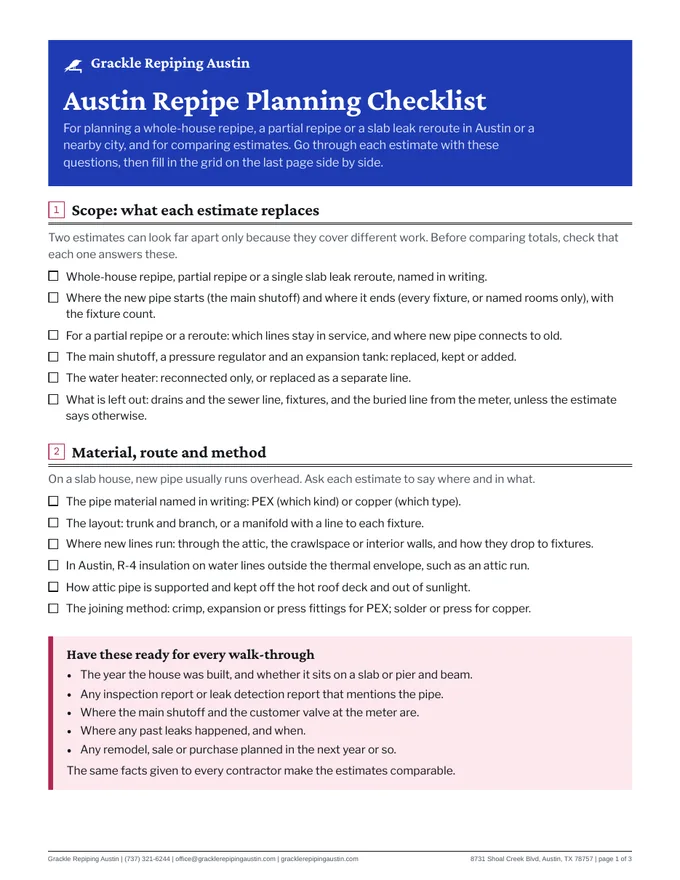
The same questions as the printable, so you can read them here first. Estimates that look far apart can turn out to cover different work, and these questions show where.
Scope: what each estimate replaces
Two estimates can look far apart only because they cover different work. Before comparing totals, check that each one answers these.
- Whole-house repipe, partial repipe or a single slab leak reroute, named in writing.
- Where the new pipe starts (the main shutoff) and where it ends (every fixture, or named rooms only), with the fixture count.
- For a partial repipe or a reroute: which lines stay in service, and where new pipe connects to old.
- The main shutoff, a pressure regulator and an expansion tank: replaced, kept or added.
- The water heater: reconnected only, or replaced as a separate line.
- What is left out: drains and the sewer line, fixtures, and the buried line from the meter, unless the estimate says otherwise.
Material, route and method
On a slab house, new pipe usually runs overhead. Ask each estimate to say where and in what.
- The pipe material named in writing: PEX (which kind) or copper (which type).
- The layout: trunk and branch, or a manifold with a line to each fixture.
- Where new lines run: through the attic, the crawlspace or interior walls, and how they drop to fixtures.
- In Austin, R-4 insulation on water lines outside the thermal envelope, such as an attic run.
- How attic pipe is supported and kept off the hot roof deck and out of sunlight.
- The joining method: crimp, expansion or press fittings for PEX; solder or press for copper.
Permit, pressure and inspection
In Austin, the plumbing permit is pulled by a responsible master plumber licensed in Texas and registered with the City. Suburban cities issue their own permits.
- Who pulls the permit, and the master plumber's Texas license number.
- The permit shown as its own line, not folded into the total.
- The static pressure measured at a hose bib. Austin requires a regulator with a strainer above 65 psi, set to 65 psi or less, with an expansion tank after it.
- For a suburb: which city issues the permit and which plumbing code it uses.
- A certificate of insurance.
- Who schedules the inspections, and who will be there for them.
Openings, walls and restoration
Openings and patching are easy to leave vague. Ask for them in writing.
- How many openings, and in which rooms.
- Whether tile walls are reached from the back or a closet side.
- Who closes each opening, and to what finish: patched only, patched and textured, or painted.
- How floors, furniture and the attic access are protected.
Schedule and water
Living through a repipe depends on two things: how many working days, and when the water is off.
- The number of working days.
- The water-off windows. Water should be back on at the end of each work day.
- In a multifamily building: which unit is without water and when, and how residents are told.
Testing and handover
These steps make the new pipe trustworthy before the walls close.
- A pressure test before any wall is closed, and the City inspection.
- Flushing after cutover, with aerators and screens cleaned.
- Shutoffs labeled.
- What old pipe stays capped in the slab or walls, and what old pipe stays in service.
- A copy of the permit and inspection sign-off for your records.
- Any written warranty: what it covers, for how long, and who honors it.
- The payment schedule, tied to stages of the work.
The side-by-side grid
The last page is a grid with one column per estimate. A blank box is a question to ask before signing.
- Contractor, master plumber and license number
- Scope: whole, partial or reroute; fixture count
- Material, layout and joining method
- Route: attic, crawlspace, walls
- Regulator, expansion tank, main shutoff
- Openings, and who closes them
- Permit, and who pulls it
- Working days
- Water-off windows
- Pressure test and inspection
- Not included (meter line, drains, heater)
- Total estimated
Have these ready for every walk-through
- The year the house was built, and whether it sits on a slab or pier and beam.
- Any inspection report or leak detection report that mentions the pipe.
- Where the main shutoff and the customer valve at the meter are.
- Where any past leaks happened, and when.
- Any remodel, sale or purchase planned in the next year or so.
Giving every contractor the same facts is what makes the estimates comparable.
Get the printable checklist
Send the short form and the download link appears right under it. If you would like a walk-through as well, say so in the message.
Call (737) 321-6244Grackle Repiping Austin8731 Shoal Creek Blvd, Austin, TX 78757
office@gracklerepipingaustin.com