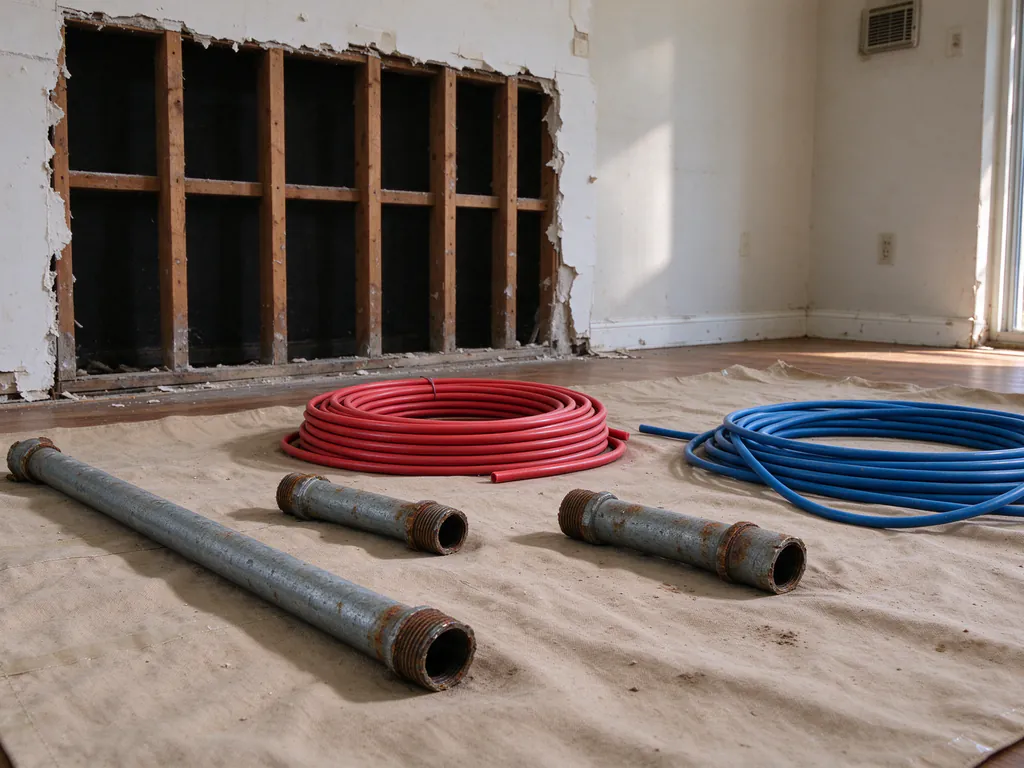
Repiping means replacing the pipe that carries drinking water through a house: the hot and cold supply lines that run from the main shutoff valve to every faucet, shower, toilet, water heater and appliance. A whole-house repipe replaces all of it; a partial repipe replaces one section; a reroute replaces one failed line by running a new one along a different path. Grackle Repiping Austin does all three across the Austin area, and this guide explains how to tell which one a house needs.
Supply pipe and drain pipe are different systems
Supply pipe is under pressure. In Austin, water arrives from the street through a meter, passes the main shutoff and branches out at whatever pressure the utility delivers, which in parts of the metro tops 80 psi. Because it is pressurized, a pinhole in supply pipe sprays or seeps constantly and runs the water meter even with every tap closed.
Drain, waste and vent pipe carries used water away by gravity. It is larger, usually cast iron or PVC, and fails by cracking, sagging or clogging. A camera finds drain problems; a pressure test finds supply problems. Repiping covers supply pipe only, and the guide on drains explains where the line falls.
The pipe Austin houses were built with
What is inside an Austin wall depends mostly on when the house was built and what has been replaced since. The identification guide shows each material with photos.
Galvanized steel was the common supply pipe in houses of the 1940s through the 1960s. It is threaded steel coated with zinc, and once the coating wears through, it rusts from the inside. In Austin, galvanized pipe is named in plumbing permit descriptions most often in 78757, 78703, 78702 and 78704, the city’s older central neighborhoods.
Copper took over from galvanized steel and is still used. It is joined by soldering or by press fittings. It can last a long time, but it can also develop pinhole leaks; the copper pinhole guide explains why.
Polybutylene is gray plastic pipe installed in many houses built from the late 1970s into the 1990s. It earned a reputation for failing at fittings and from within, and insurers and buyers often ask about it. Austin Water itself has replaced polybutylene service lines in 60 subdivisions to cut down on line breaks.
CPVC is rigid cream or tan plastic joined with solvent cement. It can turn brittle with age and heat.
PEX is flexible cross-linked polyethylene, usually red and blue, joined with crimp, expansion or press fittings. It is the most common pipe in new Austin construction and in repipes.
Many Austin houses carry more than one of these, because earlier repairs spliced new pipe into old.
What you can tell without opening a wall
A lot, but not everything. Pipe shows itself at a few places in almost every house: the water heater connections, the main shutoff, under the kitchen and bathroom sinks, behind the toilet, and in the attic or crawlspace. What you see there is a strong clue to what runs inside the walls, but not proof. Houses get partial repairs, and a copper stub under a sink can hide galvanized steel a few feet back.
Some signs point to the pipe itself:
- low flow at several fixtures on both hot and cold, not just one shower
- rusty or brown water that clears after running, especially after the water was shut off
- leaks in different places over a few years, rather than one repaired spot
- gray plastic pipe with crimp rings, or copper with green crust at joints
Others point elsewhere. Brown water only on the hot side often starts at the water heater, and a galvanized pipe replacement will not fix that. Low pressure everywhere at once, right after a regulator was replaced or the street was worked on, points to the regulator or debris. A single weak fixture is usually its aerator or cartridge. A good assessment says which signs it is relying on and what it measured.
Buying or selling a house with old pipe
Inspection reports in Austin often note galvanized steel, polybutylene or a mix of materials, and buyers then ask for a credit, a repair or a repipe before closing. The polybutylene replacement page covers the material inspection reports flag most often. The note itself does not say how much life the pipe has left. What helps a negotiation is a written scope: which materials are where, whether pressure is within Austin’s 65 psi limit, and what a partial or whole-house repipe would include. The partial repiping page explains when replacing one section is a fair answer and when it only moves the problem.
Heat, freeze and pipe in the attic
Running new pipe overhead solves the slab problem and creates two others to manage. Summer attics in Central Texas get far hotter than living space, so pipe has to be supported off the roof deck, kept out of any sunlight through vents and gable openings, and run where it will not sag. Winter brings the opposite risk. Austin freezes only a few weeks a year on average, but hard freezes do arrive, and the February 2021 storm drove 123 freeze-related plumbing permits in Austin in the following months. That is why Austin’s code requires R-4 insulation on water lines outside the thermal envelope, and why routing matters: lines tucked down into the ceiling insulation on the warm side stay safer than lines strung high under the roof. The PEX in a Texas attic guide covers the details.
Why supply pipe fails
Corrosion from the inside. Galvanized steel scales until the pipe passes a fraction of the water it was sized for. Copper can thin and pit. Water chemistry plays a part: Austin Water lime-softens its water to a pH near 9.7 and says the treatment helps coat pipes and prevent corrosion, while Round Rock, Cedar Park and Kyle deliver much harder water.
Pressure. High static pressure strains every joint and fixture. Austin’s amendment to the 2024 Uniform Plumbing Code requires a pressure regulator with a strainer when static pressure exceeds 65 psi, set to 65 psi or less, with an expansion tank downstream. Parts of Georgetown run at 80 to 100 psi.
Ground movement. Much of central, south and east Austin sits on Houston Black and similar clays that shrink and crack in dry spells and swell when wet. Pipe under or inside a slab moves with it.
Freezing. Austin freezes about a dozen days a year at Camp Mabry and about 33 at Austin-Bergstrom, and an occasional storm goes far below that. The February 2021 storm alone produced 123 freeze-related plumbing permits in Austin between February and April.
Age and installation. Fittings, supports and joints all age, and a poor installation fails sooner.
Slab leaks and reroutes
Austin is a slab town: across five years of City plumbing permits, descriptions mention slabs more than three times as often as pier-and-beam crawlspaces. When a supply line under a slab leaks, there are three ways forward.
A spot repair opens the floor and the slab at the leak and fixes that section. It suits one leak in otherwise sound pipe, where the spot can be reached.
A reroute abandons the leaking line and runs a new one overhead through the attic and down the walls. Austin plumbing permits describe it in plain words, such as “Abandon the leaking 3/4 hot water line in the foundation & reroute it overhead in the attic.” It avoids breaking the slab and takes that line out of the ground for good.
A whole-house repipe replaces every supply line, usually overhead, and is the better choice when leaks keep coming or the pipe material itself is the problem.
The repair or reroute guide and the slab leak reroute page go deeper, and the signs guide covers how a slab leak announces itself.
What Austin’s code requires
The City of Austin adopted the 2024 Uniform Plumbing Code with local amendments, effective July 10, 2025. For a repipe, three amendments matter most:
| Rule | What it requires |
|---|---|
| Who can pull the permit | A responsible master plumber licensed by the Texas State Board of Plumbing Examiners and registered with the City |
| Pressure | A regulator with a strainer above 65 psi static, set to 65 psi or less, and an expansion tank downstream |
| Attic and exterior runs | At least R-4 insulation, five-eighths of an inch thick or more, on water lines outside the thermal envelope |
The suburbs write their own rules. Round Rock enforces the 2024 International Plumbing Code with a one-permit system; Cedar Park, Leander and Kyle use the 2021 International Plumbing Code; Georgetown’s permits reach some homes outside its city limits where it supplies the utilities. The Austin repipe permit guide explains each.
How a repipe decision gets made
A good assessment moves from what you can see to what has to be measured.
- Material. Pipe is checked at the water heater, the main shutoff and under sinks, and sometimes in the attic or crawlspace.
- Pressure and flow. A gauge on a hose bib reads static pressure; flow is checked at several fixtures. Low flow at one fixture points to that fixture; low flow everywhere points to the main, the regulator or the pipe.
- Leak history. One leak is a repair question. Repeated leaks in different places are a repipe question.
- Routes. Attic headroom, crawlspace access and which walls back onto bathrooms decide where new pipe can go and how many openings it needs.
- Scope. Repair, reroute, partial repipe or whole-house repipe, written down with what stays.
A symptom alone rarely proves a cause. Low pressure can be a failing regulator; rusty water can be the water heater. The low water pressure guide walks through those checks.
What a whole-house repipe involves
New lines are run while the old system still works, then each fixture group is cut over. In a slab house the new pipe usually runs through the attic and drops down interior walls; in a pier-and-beam house it can run through the crawlspace. Water heater connections are rebuilt, shutoff valves replaced where needed, and a regulator and expansion tank added if pressure calls for them. The new system is pressure tested and inspected before walls close, then flushed. Old pipe that can be reached is removed; pipe in the slab or sealed walls is usually capped and left in place. Openings are patched to the scope in the estimate. The timeline guide covers how the days usually go.
Not sure which scope fits your house?
A walk-through checks the pipe, the pressure and the routes before anyone talks about a repipe.
What repiping costs in Austin
A typical Austin-area range for a whole-house repipe is $4,500 to $15,000+, and about $4,500 to $9,000 for PEX with typical access. A slab leak reroute typically runs about $4,000 to $9,750 before leak detection. The number of bathrooms, a second story, the route and the material move a house within those ranges. The Austin repipe cost guide explains each factor, and the cost estimator gives a range for your house.
Insurance and help with the cost
Homeowners policies in Texas differ, and many pay for water damage and for tearing out what was in the way of a leak, but not for the failed pipe itself. The Texas Department of Insurance explains what to look for. The City of Austin’s Plumbing Repair Program offers grants of up to $15,000 for critical plumbing repairs to homeowners at or below 100% of median family income, and Austin Water replaces galvanized service lines it has flagged on the owner’s side of the meter. The slab leak insurance guide covers coverage questions in detail.
Living with new pipe
New pipe lasts longest when pressure stays at or below 65 psi, attic runs stay insulated and supported, and the main shutoff works. Know where the main shutoff is, test it once a year, and note how the house was repiped and where any old pipe was left in place. That record helps the next owner, the next inspector and the next plumber.