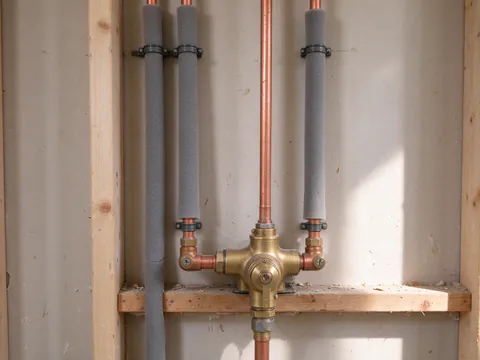
Austin Water’s water is moderately hard, not very hard: its 2025 report puts total hardness at 70 to 126 ppm, averaging 93 ppm, or about 5.4 grains per gallon. So does Austin have hard water? Somewhat, and less than its neighbors: Round Rock, Cedar Park and Kyle report far harder water. Grackle Repiping Austin repipes houses served by each of these utilities, and this guide explains what their water does to pipe.
Hardness by utility
Hardness depends on who supplies the house, not on the city name in the address. Each utility publishes an annual water quality report; these are their own figures.
| Utility | Source water | Hardness reported | Disinfectant |
|---|---|---|---|
| Austin Water | Lake Travis and Lake Austin, from the Lower Colorado River | 70 to 126 ppm, average 93 ppm (about 5.4 gpg) | Chloramine, average 2.3 ppm |
| City of Round Rock | Lake Georgetown, the Edwards Aquifer and Lake Travis | Average 249 mg/L (about 14.6 gpg), described as very hard | Chloramine, average 2.41 ppm |
| City of Cedar Park | Lake Travis | 183 ppm | Chloramine, average 3.09 ppm |
| City of Kyle | Purchased surface water plus Edwards and Barton Springs aquifer wells | 275 to 295 mg/L | Free chlorine |
| City of Leander | Lake Travis and the Brushy Creek Regional plant | No hardness value in its report | Chloramines, 2.40 mg/L |
| City of Georgetown | Lake Georgetown and Lake Travis | No hardness value found in its report | Total chlorine |
Round Rock’s average is roughly 2.7 times Austin Water’s. Kyle says groundwater is the main contributor to its hardness, which fits: water that sits in limestone aquifers picks up calcium and magnesium, while Austin’s lake water is softened at the plant. For Leander, Georgetown, Pflugerville and the West Travis County utility, no hardness figure appeared in the reports reviewed, so ask the utility or test at the tap.
Austin’s lime softening and pH
Austin Water does more than disinfect. Its plants lime-soften the water, and the City’s water quality lab reported a pH of 9.6 to 9.9 leaving the Davis, Ullrich and Handcox plants in its July 2026 summary, with hardness of 73 to 78 mg/L. Austin Water says its lime softening process “helps coat pipes and prevent corrosion.” Its 2024 tap sampling found copper at the 90th percentile below 0.008 ppm and lead below 1.0 ppb, with no exceedances.
Those numbers matter for pipe. Water with a high pH and a modest mineral content tends to lay down a thin protective layer inside metal pipe rather than eat it away. That is a utility-wide average, though, not a guarantee for every house. Water that sits in a hot loop, runs fast through undersized pipe or meets an old galvanized section behaves differently from water at the plant.
Pipe scale buildup
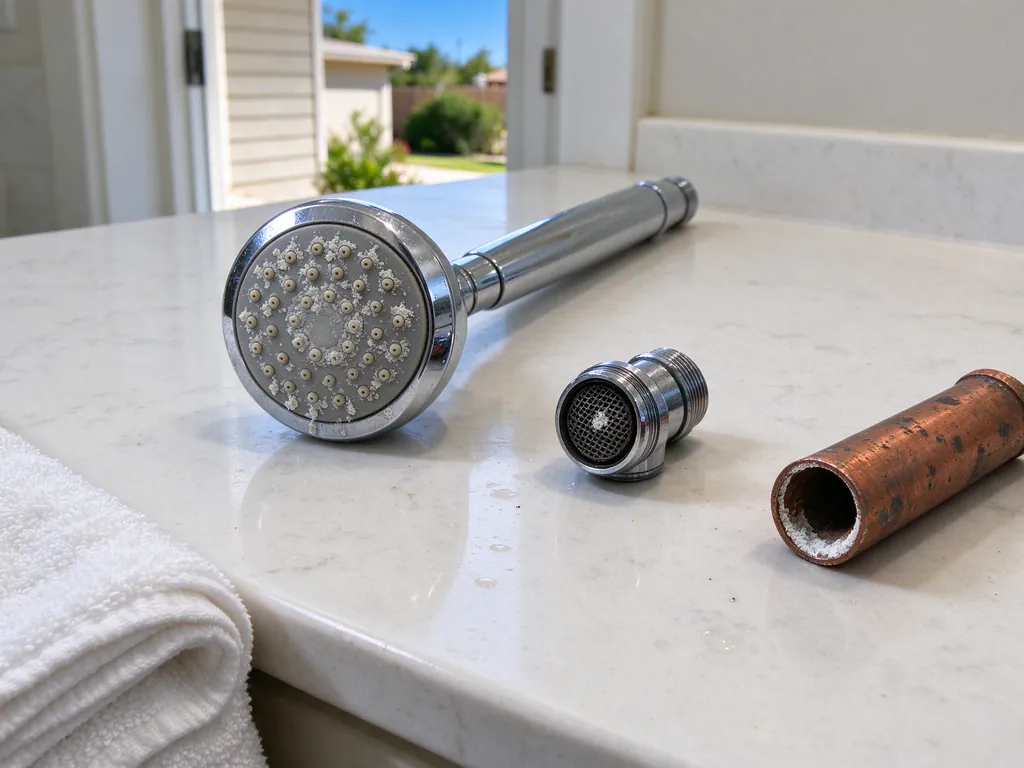
Scale is calcium carbonate and other minerals that drop out of water. It forms fastest where water is heated, where it slows or where it evaporates:
- Water heaters. Heating drives minerals out, so tank bottoms collect sediment and tankless heat exchangers scale. This happens faster in Round Rock or Kyle than in Austin.
- Fixtures. Aerators, showerheads, cartridges and toilet fill valves collect scale and lose flow.
- Hot-side piping. Hot lines can scale more than cold lines, particularly near the heater.
In copper and PEX supply lines, hardness alone rarely closes a pipe enough to matter in a house. In a home with old pipe, low flow more often traces to galvanized pipe that has rusted shut from the inside, which is corrosion rather than hardness. If flow is weak at one fixture, start with its aerator or cartridge. If it is weak everywhere, the low water pressure guide explains how to separate a regulator problem from a pipe problem.
Weak flow, scale or leaks?
A first visit checks the pipe material, static pressure at a hose bib and where the problem starts before any repipe is discussed.
Aggressive water and corrosion
Hard water and corrosive water are not the same thing, and in some ways they are opposites. Water that is soft, low in pH or low in alkalinity can be aggressive: it dissolves metal rather than coating it. Hard water with a high pH tends to leave a mineral film instead.
Corrosion inside a pipe depends on several things at once:
- pH and alkalinity. Low pH and low alkalinity favor corrosion of copper and steel. Austin’s softened water runs at a high pH by design.
- Disinfectant. Chlorine and chloramine are oxidizers. Chloramine is also known to be harder on some rubber parts than free chlorine, so toilet flappers, washers and some valve seals may wear sooner.
- Velocity. Fast water, especially hot water from a recirculation pump, can wear copper at elbows and tees.
- Temperature. Hot water speeds every chemical reaction.
- Mixed metals. Copper connected straight to galvanized steel without a proper fitting can corrode the steel at the joint.
The copper pinhole guide explains how these combine into pinholes in copper, and why no single cause explains every case.
What it means for each pipe material
Galvanized steel. Its zinc coating wears through, and the steel underneath rusts from the inside until the bore narrows. Austin’s water chemistry may slow that, but decades of age have already done the work in older central neighborhoods. Austin Water has flagged 738 active residential meters for galvanized service line replacement, concentrated in 78704, 78757, 78702 and 78751.
Copper. Generally does well in water like Austin Water’s. Problems tend to come from installation, velocity or a local water condition rather than from hardness. The copper repiping page covers when copper is still the right choice.
PEX. Hardness does not affect the tubing itself. Disinfectant does, slowly, which is why PEX carries a chlorine-resistance rating; the PEX safety guide explains it. Scale at fixtures happens either way.
CPVC and polybutylene. Both are plastic, so hardness does not corrode them. Age, heat and fittings drive their failures; the pipe identification guide shows how to tell what you have.
Softeners, filters and the plumbing permit
A whole-house softener reduces scale on fixtures and water heaters. It is a choice for the household, and it does not replace failing pipe. Rules on installing one vary: Kyle’s permit handout lists installing or replacing a water softener among work that needs a permit, and Bee Cave requires permits for water softener work. In Austin, permit rules follow the City’s plumbing code amendments; the Austin repipe permit guide explains what requires one.
If a softener is planned along with a repipe, it is easier to leave a loop or tees for it at the main while the walls are open.
When hard water is not the problem
Hardness gets blamed for a lot. Before deciding the water is ruining your pipes, check the more likely causes:
- Brown or rusty water that clears after running usually points to galvanized pipe or the water heater.
- Repeated leaks in different places suggest a pipe material at the end of its life, or high pressure. Austin’s code requires a regulator above 65 psi static, set to 65 psi or less, with an expansion tank downstream.
- Low flow everywhere often traces to a failing regulator or a restricted main.
A whole-house repipe fixes pipe that has failed; it does not soften water. The PEX vs copper guide explains how the water your utility delivers should shape the material choice if a repipe is needed.