Yes. PEX tubing sold for drinking water is tested against NSF/ANSI 61, the national standard for the health effects of products that touch drinking water, and certified tubing carries that mark on its printed line. Certification limits what the pipe may add to the water. It does not make PEX immune to failure, and it does not settle every open question. Grackle Repiping Austin offers and manages PEX repipes across the Austin area, and this guide explains what “safe” covers.
What NSF/ANSI 61 certification means
NSF/ANSI 61 is a standard for drinking water system components: pipe, fittings, valves, tanks and the like. A product certified to it has been exposed to test water, and the water has been analyzed for what extracted from the product. Each contaminant found must stay under a limit set on health grounds. Certifiers also audit the factory, so the certification covers ongoing production, not one sample.
The same standard shows up elsewhere in Austin’s code. Austin’s amendment 608.2 requires an NSF 61 expansion tank downstream of a pressure regulator, which is the same family of test applied to a different part.
What certification does not cover is just as useful to know:
- It does not rate durability. A certified pipe can still leak at a bad fitting or crack in a freeze.
- It does not cover installation. Uncertified fittings, unlisted transitions or tubing left in sunlight are installation problems, not material ones.
- It does not measure microplastic particles. The test looks at chemical compounds extracted into water.
How to read the print line on PEX tubing
PEX tubing is printed every few feet with its details. On tubing meant for drinking water, expect to find:
- the material and type, such as PEX-A or PEX-B
- the tubing standard it is made to
- pressure and temperature ratings for cold and hot water
- a chlorine-resistance designation
- a potable water certification mark, often written as NSF-pw, sometimes alongside NSF 61
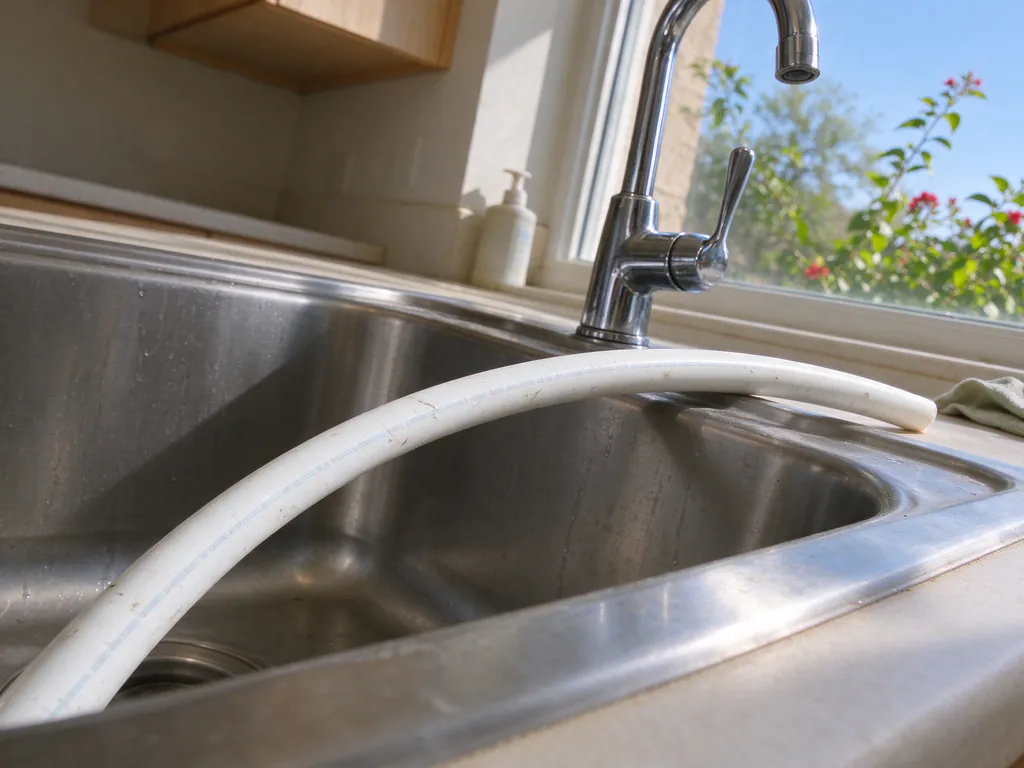
If you can see tubing at the water heater, under a sink or in the attic, read the print line. Unprinted or unreadable tubing is a question to raise during an assessment, not proof of a problem. The pipe identification guide shows where pipe is visible in a typical house and how PEX differs from polybutylene, which can look similar.
Taste, odor and what leaches from new pipe
New plastic pipe can release small amounts of compounds from manufacturing in its first weeks of use, which some people notice as a faint plastic taste or odor, especially from water that sat overnight in the hot lines. Certification is what keeps those compounds under health-based limits; flushing is what clears most of them. A repipe ends with a flush of every fixture after the pressure test, and running cold water for a minute after it has sat for a long stretch helps in the first weeks.
A taste or odor that persists, that starts suddenly in an older system, or that comes only from the hot side points elsewhere. Water heaters commonly cause hot-side odor. The low water pressure guide and the Austin hard water guide cover other changes people notice at the tap.
Chlorine, chloramine and PEX
Utilities add disinfectant so water stays safe all the way to the tap. That same disinfectant, especially in hot water, slowly oxidizes PEX from the inside over its life. The tubing standards therefore test PEX against chlorinated hot water and assign a chlorine-resistance rating, printed on the tubing. Higher ratings are meant for harder service, such as a hot-water recirculation loop that keeps hot disinfected water moving through the pipe all day.
The disinfectant depends on who supplies the house:
| Utility | Disinfectant reported | Level reported |
|---|---|---|
| Austin Water | Chloramine | 0.06 to 3.1 ppm, average 2.3 ppm |
| Round Rock | Chloramine | average 2.41 ppm |
| Cedar Park | Chloramine | average 3.09 ppm |
| Leander | Chloramines | 2.40 mg/L |
| Kyle | Free chlorine | averages of 1.43 and 1.81 mg/L at two systems |
| Georgetown | Total chlorine | see the City of Georgetown water quality report |
These are each utility’s own reported figures. What matters for the pipe is matching the tubing’s rating to the service it will see, keeping hot water within the tubing’s temperature rating, and thinking twice about a recirculation pump that runs around the clock. The PEX vs copper guide explains how the same water affects copper.
Not sure what is in your walls?
A first visit reads the pipe where it shows, checks static pressure at a hose bib and explains what the material means for the house.
Microplastics and plastic pipe
People increasingly ask whether PEX sheds microplastics into drinking water. The honest answer is that there is no settled measure for how much, if anything, household plastic pipe contributes, and no drinking water standard for microplastic particles to test it against. NSF/ANSI 61 addresses chemical compounds extracted into water, not particles. Copper and galvanized pipe raise their own questions about metals. If microplastics are your deciding concern, that is a reasonable preference to state, and copper is the alternative; the copper repiping page covers what it involves.
Where PEX can fail
Safe to drink from is a different question from durable, and PEX can fail. The ways it does are well understood:
- Sunlight. Ultraviolet light breaks PEX down. Tubing must be covered or shielded where light reaches it, including near attic gable vents.
- Fittings. Crimp rings set wrong, fittings not rated for the tubing, or brass fittings that corrode in some waters can leak while the tubing is fine.
- Heat and support. Tubing run on a hot roof deck or left to sag wears faster. The PEX in a Texas attic guide covers routing.
- Freeze. PEX tolerates ice better than copper but is not freeze-proof; fittings and fixtures can crack.
- Contaminated soil. Buried PEX can be permeated by petroleum products and solvents, so it is kept away from them in yard lines.
Homeowners in Austin-area forums report early leaks in PEX systems in houses only ten or so years old, and one reports a house repiped through the attic after repeated leaks from its original under-slab PEX. Those are individual accounts, not a measured failure rate, and no product line is singled out here. They are a reason to check the print line, the fittings and the installation, not a reason to fear PEX as a material.
Choosing PEX with confidence
If PEX is the plan for your house, three checks cover the ground this guide describes. The tubing carries a potable water certification mark and a chlorine rating suited to the service. Fittings and transitions are listed for that tubing. Routing keeps it out of sunlight, supported and on the warm side of attic insulation, with the R-4 insulation Austin’s code requires on lines outside the thermal envelope. A PEX repipe in Austin is then pressure tested and inspected by the City before walls close, and flushed before you use it. The repipe cost guide explains what that work typically costs, and the whole-house repiping page explains the full scope.