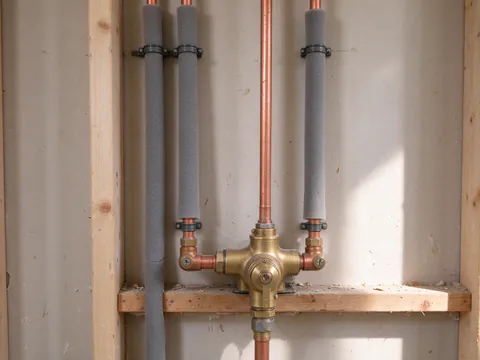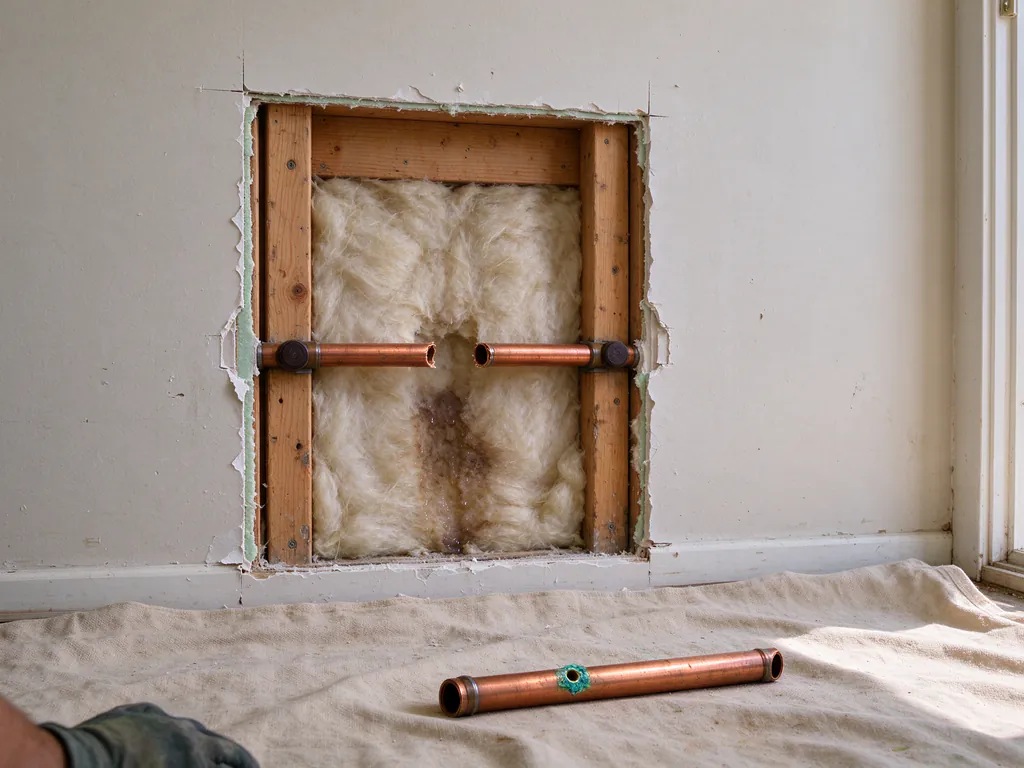
A pinhole leak in copper pipe is a small hole where the pipe wall has thinned until water breaks through. There is no single cause. Pitting from water chemistry, fast-moving water, installation leftovers such as flux and burrs, and outside contact with soil or concrete can each do it. Grackle Repiping Austin offers copper repairs, partial repipes and whole-house repipes, and the leak pattern decides which one fits.
How copper pipe wall thinning becomes a leak
Copper water pipe in a house has a thin wall to begin with. Over years, the inside surface either builds a stable protective film or loses metal. When metal loss is spread evenly, the pipe lasts a long time. When it concentrates in small spots, those spots deepen into pits, and a pit eventually reaches the outside. That is the pinhole.
Because the process is slow and local, a pinhole rarely arrives alone. The conditions that made one pit usually exist elsewhere along the same line. That is why the location of each leak, and how far apart in time they come, tells more than the leak itself.
What you might see first:
- a damp spot or stain on drywall or a ceiling below a run of pipe
- a fine spray or a bead of water at a pipe, often with blue-green crust around it
- a water meter that moves with every tap closed
- a higher water bill with no change in use; homeowners report a surprise bill as the first sign of a hidden leak
In a slab house, a pinhole under the floor shows up as a warm spot, the sound of running water or a damp floor; the slab leak signs guide covers those.
The mechanisms behind pipe corrosion
Pitting from water chemistry. Certain combinations of pH, alkalinity, disinfectant, dissolved oxygen and minerals let small spots on the copper surface corrode faster than the rest. Cold-water pitting and hot-water pitting form under different conditions, which is one reason pinholes cluster on one side of the system in some houses.
Erosion corrosion from velocity. Fast water scrubs away the protective film, especially just past elbows, tees and fittings where flow turns. Hot water speeds this. A recirculation pump that runs constantly, an oversized pump, or pipe that is undersized for the flow it carries all raise velocity. The damage often shows as a smooth, horseshoe-shaped worn spot downstream of a fitting.
Installation conditions. Excess flux left inside the pipe keeps working on the copper after the job is done. Cut ends that were not reamed leave a burr that makes turbulence. Pipe that rubs on framing or a hanger can wear through from the outside.
Outside corrosion. Copper that sits against soil, concrete or certain insulation can corrode from the outside in. Under a slab, moisture and soil chemistry act on the pipe for decades.
Electrical conditions. Stray current or a poor electrical ground bonded to the water pipe is sometimes blamed. It can contribute, but it is easy to assume and harder to prove; it should be checked rather than taken as the answer.
These overlap. A single house can have two or three of them at once, and the cause in one house does not prove the cause next door. A cut-out section of failed pipe, split lengthwise, often shows whether the damage started inside or outside and whether it is spread out or concentrated.
What Austin water and soil add
Austin Water lime-softens its water and reports a pH near 9.7 leaving its plants, and it says the softening “helps coat pipes and prevent corrosion.” Its 2024 tap sampling found copper at the 90th percentile below 0.008 ppm, with no exceedances. That is good news for copper, but it is a citywide average. It does not rule out velocity damage, installation problems or local conditions in one house. Suburban water differs: Round Rock, Cedar Park and Kyle report much harder water, and Kyle uses free chlorine rather than chloramine. The Austin hard water guide compares the utilities.
Soil adds the outside half of the story. Much of central, south and east Austin sits on Houston Black and similar clays that crack in dry spells and swell when wet. Copper run in or under a slab moves with that soil and sits against it. Austin permit descriptions include plain wording like “Failed copper pipe inside of slab,” and where a house has copper under the floor, a leak there is usually handled by rerouting the line overhead rather than breaking the slab.
Second or third pinhole?
A walk-through maps where the leaks have been, checks static pressure and any recirculation pump, and sets out repair, partial and whole-house options as written lines.
Pinholes in galvanized pipe
Galvanized steel gets pinholes too, by a different route. Its zinc coating wears away, the steel underneath rusts from the inside, and the thinnest points, usually the threaded joints, rust through first. A pinhole in galvanized pipe is rarely an isolated defect. Rust inside has usually narrowed the bore as well, which is why the same houses report weak flow and brown water. The galvanized pipe replacement page covers that work.
Repair, replace a section or repipe
The choice turns on the pattern, not the single leak.
| Situation | Usual answer | Why |
|---|---|---|
| One pinhole, pipe around it looks sound | Cut out and repair the section | The rest of the pipe has not shown the same problem |
| Two or more pinholes on the same run | Replace that run | The run shares the same water, velocity and installation |
| Leaks in different places over a few years | Partial or whole-house repipe | The cause is likely system-wide |
| Pinholes only on the hot side near a recirculation pump | Fix the pump and velocity, then replace damaged runs | Repiping without fixing the flow repeats the damage |
| Leak in copper under a slab | Reroute overhead, or repipe if the slab lines keep failing | Avoids breaking the slab and takes the line out of the ground |
A partial repipe suits a house where the problem is confined to one section, such as a hot-water branch. A whole-house repipe makes sense when pinholes keep appearing in different places, the pipe walls prove thin wherever a section is cut, or an addition or remodel will open the walls anyway.
If you repipe, the question of material comes next. Copper again is a reasonable choice when the cause was installation or velocity that will be corrected; PEX is common when the cause looks like the water or soil. The PEX vs copper guide and the copper repiping page compare them.
Lowering the risk in copper you keep
Copper you keep can be protected. Keep static pressure at or below 65 psi: Austin’s code requires a regulator above that, with an expansion tank downstream, and the pressure-reducing valve guide explains the check. Set a recirculation pump to run on a timer or on demand rather than around the clock. Have any repair cut out the damaged length and use proper fittings rather than clamps. Note where each leak was, with the date, so the next decision rests on a pattern instead of a guess. Homeowner insurance is a separate question from the pipe itself; the slab leak insurance guide covers what policies tend to separate.