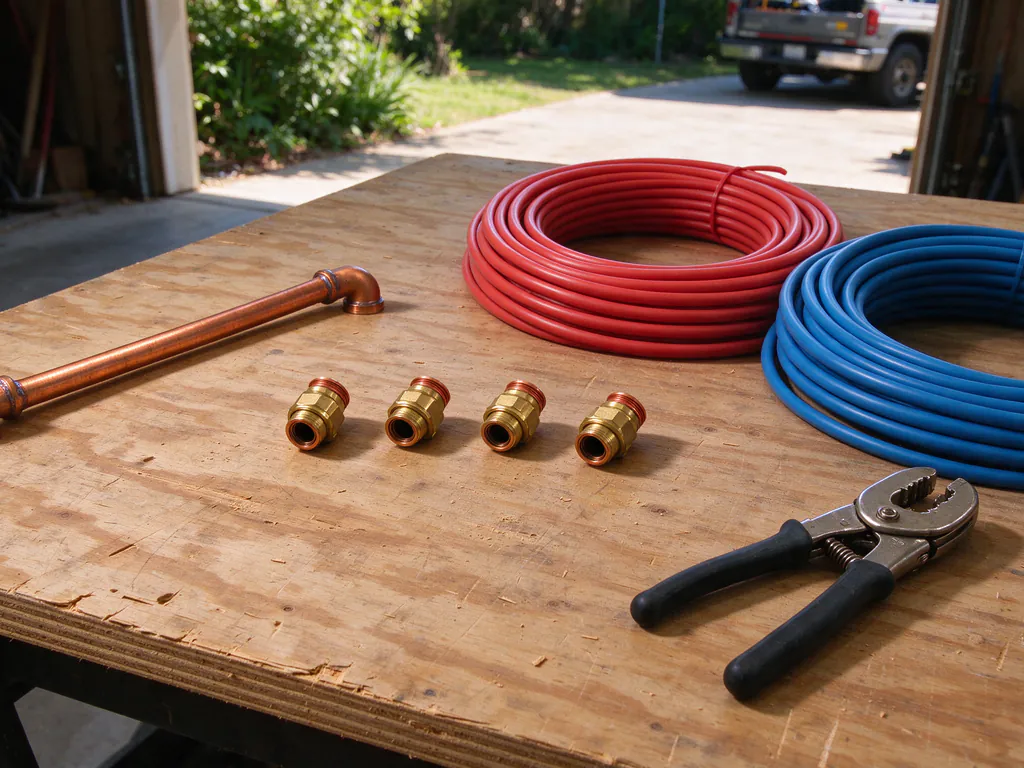
There is no universal winner in the PEX vs copper choice. For an Austin repipe, PEX usually costs less and needs fewer wall openings because it runs in long flexible lengths, and it shrugs off a freeze better. Copper costs more, tolerates heat and exposure better and has a long service record. The right pick depends on the house, its access and its water. Grackle Repiping Austin offers and manages repipes in both materials, and this guide explains how the choice gets made.
The short comparison
| PEX | Copper | |
|---|---|---|
| What it is | Flexible cross-linked polyethylene tubing, usually red, blue or white | Rigid copper tube joined by soldering or press fittings |
| Typical Austin-area cost, whole house | about $4,500 to $9,000 with typical access | Higher for the same house; priced from the layout and access |
| Joints in a typical layout | Few; long runs bend around corners | Many; every change of direction is a fitting |
| Wall and ceiling openings | Usually fewer, since tubing can be fished | Usually more, since rigid lengths need straight access |
| Freeze | Tubing can stretch slightly; fittings and fixtures can still crack | Tends to split when water freezes inside |
| Attic heat and sunlight | Must be shielded from sunlight and supported off hot roof decking | Tolerates heat and exposure |
| Water chemistry | Rated for chlorine resistance; printed rating matters on hot loops | Can pit or thin under some water and flow conditions |
| Noise | Flexible tubing softens water hammer | Transmits hammer and flow noise more readily |
Both are approved for water distribution under the 2024 Uniform Plumbing Code that Austin adopted with local amendments, effective July 10, 2025, and under the International Plumbing Code editions used in Round Rock, Cedar Park, Leander and Kyle. Code rarely makes the decision for you. The house does.
Plastic piping systems: where PEX fits
PEX belongs to a family of plastic water pipe that has changed a lot in fifty years, and the history explains why some owners distrust plastic. Polybutylene, the gray pipe of the late 1970s into the 1990s, earned a reputation for failing at its fittings and from within; Austin Water has replaced polybutylene service lines on the public side of the meter in 60 subdivisions to cut line breaks. CPVC is rigid and glued, and can turn brittle with heat and age, as the CPVC replacement guide explains. PEX is a different material from both: polyethylene whose molecules are cross-linked so it holds up to hot water and pressure.
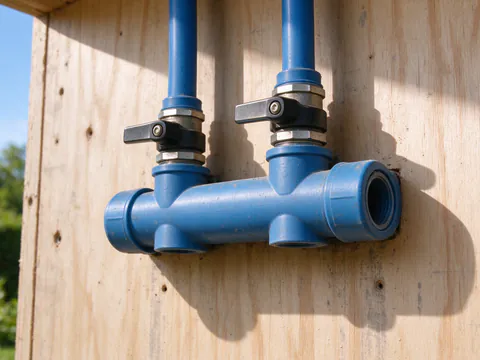
PEX comes in three types named for how the cross-linking is done. PEX-A is the most flexible and can be joined with expansion fittings that keep the full inside diameter. PEX-B is stiffer and is usually joined with crimp or press rings. PEX-C is less common in repipes. All are made to the same national tubing standards, and the printed line on the tubing lists the standard, the pressure and temperature rating and a chlorine-resistance code. The PEX repiping page covers the fitting systems and manifold layouts in more detail.
Austin permit records show where new work has gone. Across five years of City of Austin plumbing permit descriptions, PEX is named 225 times and copper 87 times. That is a count of words in permit text, not a measure of what is inside Austin walls, but it points the same way as the trade: PEX is the default for new runs, and copper is a deliberate choice.
Cost and access in an Austin house
The material changes the price twice: once for the pipe and fittings, and again for the labor and openings it takes to install them. A typical Austin-area range for a PEX whole-house repipe with typical access is about $4,500 to $9,000. Slab homes that need long overhead runs and larger homes run higher. A copper repipe has no separate published range here; it is priced from the layout, and it generally lands above PEX for the same house because every turn is a joint and rigid lengths need straighter access.
Access is where Austin houses differ. City plumbing permits mention slabs more than three times as often as pier-and-beam crawlspaces, and a slab house is usually repiped overhead: new lines run through the attic and drop down interior walls. Flexible tubing can be fished down a wall cavity through a small opening at the top and bottom. Copper usually needs a taller opening or a run along the outside of the framing. Where a house has a crawlspace, both materials can run underneath with fewer openings, and the cost gap narrows. The Austin repipe cost guide explains every line in a repipe price.
Attic heat and freeze
Overhead routing solves the slab problem and moves the pipe into the hardest space in a Texas house. Summer attics get far hotter than living space, and winter brings the occasional hard freeze. Austin averages about 12 freezing days a year at Camp Mabry and 33 at Austin-Bergstrom, and storms like February 2021 go far below that: 123 freeze-related Austin plumbing permits followed in the next three months.
PEX in heat. PEX is rated for hot water, but sunlight degrades it, so tubing near gable vents or attic openings needs shielding. It expands and sags more than copper as temperatures swing, so it has to be supported at the manufacturer’s spacing and kept off the roof deck.
Copper in heat. Copper does not care about sunlight and holds its line. It does conduct heat, so an uninsulated cold line in a hot attic delivers warm water.
Freeze. PEX tubing can stretch a little as ice forms and often survives a freeze that would split copper. That is not the same as freeze-proof. Fittings, valves and the fixtures downstream can crack, and homeowners report attic PEX freezing in Austin cold snaps even with insulation. Austin’s local amendment 312.6.1 requires at least R-4 insulation, five-eighths of an inch thick, on water lines outside the building’s thermal envelope, whichever material is used. Routing matters as much as material: lines tucked down into the ceiling insulation stay warmer than lines strung high under the roof. The PEX in a Texas attic guide and the frozen pipes guide go deeper.
Want both materials priced for your house?
An estimate can show PEX and copper side by side, with the route, the openings and the patch scope as separate lines.
Austin water, hard water and disinfectant
Water chemistry is the main reason people ask whether copper or PEX is better for hard water, and the answer depends on which utility feeds the house.
Austin Water draws from Lake Travis and Lake Austin and lime-softens its water. Its 2025 report puts total hardness at 70 to 126 ppm, averaging 93 ppm (about 5.4 grains per gallon), and the City’s lab reports a pH near 9.7 leaving the plants. Austin Water says the lime softening helps coat pipes and prevent corrosion, and copper at the 90th percentile of its 2024 tap sampling was below 0.008 ppm. The disinfectant is chloramine. In the suburbs the picture changes: Round Rock reports an average hardness of 249 mg/L and calls it very hard water, Cedar Park reports 183 ppm, and Kyle reports 275 to 295 mg/L and disinfects with free chlorine instead of chloramine.
What that means for the choice:
- Hard water leaves scale mostly where water is heated or slows down: water heaters, aerators, cartridges and showerheads. It affects the fixtures on a PEX system and a copper system alike. It does not by itself make one pipe material the clear winner.
- Copper can develop pinhole leaks under some combinations of water chemistry, flow velocity and installation. High pH and a protective scale layer work in copper’s favor, which is part of why Austin Water’s softening matters. The copper pinhole guide explains the mechanisms.
- PEX carries a chlorine-resistance rating because chlorinated hot water slowly attacks plastic. The rating matters most on a hot-water recirculation loop that keeps hot water moving through the pipe all day.
The Austin hard water guide compares each utility’s figures.
Joints, fittings and where failures start
A pipe system fails at its weakest point, and that point is usually a joint. Copper joints fail when solder was underheated, flux was left inside, or a cut end was not reamed and the water turbulence wore the wall thin. PEX joints fail when a crimp ring was set wrong, a fitting was not rated for the tubing, or tubing was kinked and patched. Homeowners in Austin-area forums report early leaks in PEX systems in houses only ten or so years old; those are individual accounts, not a measured failure rate, and they are a reminder that fittings and installation matter as much as the tubing.
A layout choice changes the joint count too. A manifold layout sends one line from a central manifold to each fixture with no hidden joints in the walls, and suits PEX. A trunk-and-branch layout runs a main line with tees to each fixture, and is how copper is usually installed. Either can be done well. Both get a pressure test, then a City inspection in Austin, before walls close; the Austin repipe permit guide covers that sequence.
How to choose for one house
Let these questions decide it rather than a general preference:
- What does the access look like? A slab house with a roomy attic and interior walls favors PEX; a crawlspace narrows the cost gap.
- How much pipe will be exposed? Runs near gable vents, on exterior walls or outdoors favor copper or shielded PEX.
- Who supplies the water? Austin’s softened, high-pH water is gentler on copper than very hard or low-pH water can be; a recirculating hot loop needs PEX with the right chlorine rating.
- Is there a recirculation pump? It raises flow velocity in copper and exposure to hot chlorinated water in PEX; both have design limits to respect.
- What is the budget? PEX usually leaves room for a pressure regulator, insulation and better patching within the same spend.
A mixed system is common and sensible: copper at the water heater and exposed stubs, PEX through the attic and walls, with listed transition fittings where they meet. Whatever the mix, the estimate should name the material for each run.
Before you decide
Two things are worth checking before material comes up at all. Is the pressure within Austin’s limit? Amendment 608.2 requires a regulator with a strainer above 65 psi static, set to 65 psi or less, with an expansion tank downstream, and high pressure shortens the life of any pipe; the pressure-reducing valve guide explains the check. And is a whole-house repipe really the scope? One failed line may only need a slab leak reroute; the is repiping worth it guide and the whole-house repiping page walk through that call. The repipe assessment asks about your house, and the first visit checks the pipe, the static pressure at a hose bib and the attic or crawlspace before anyone recommends a material.