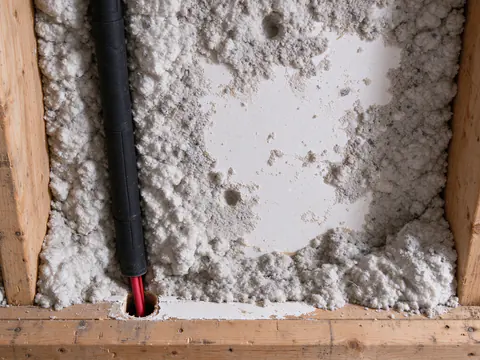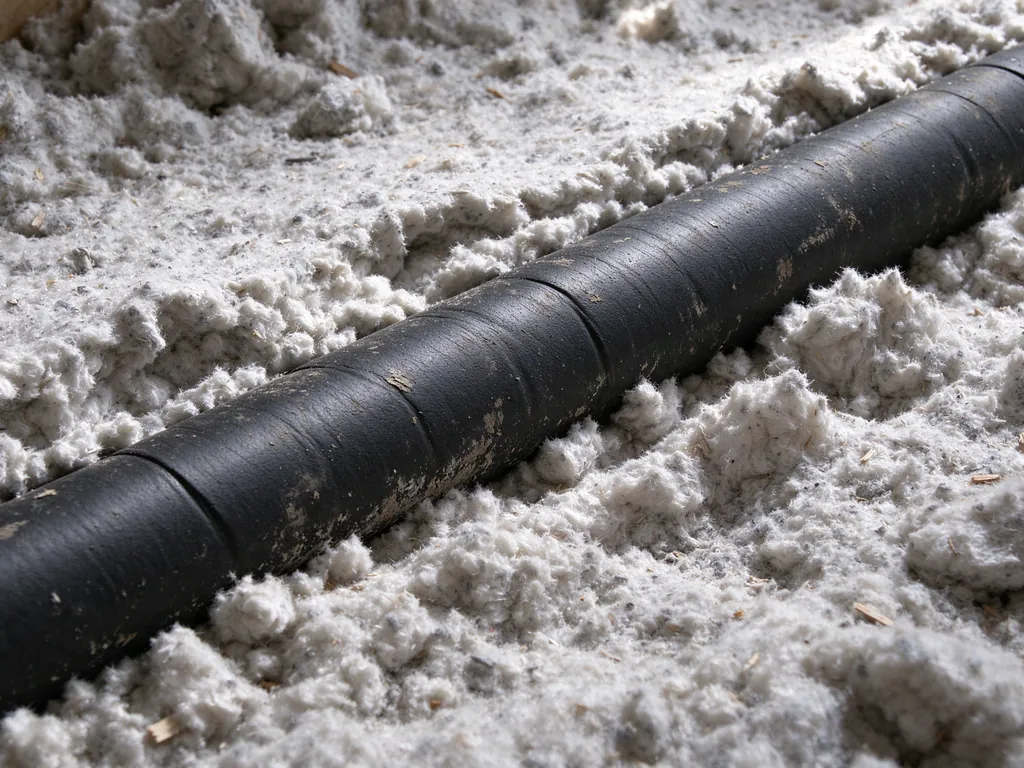
Yes. PEX can run through a Texas attic, and in a slab house that is where a reroute or repipe usually goes: the new line goes overhead through the attic and drops down inside walls to each fixture. What makes it work is the detail. In Austin the code requires R-4 insulation on attic water lines, and the line also needs routing away from the cold roof deck, protection from sun, and supports that let it expand. Grackle Repiping Austin offers and manages attic reroutes and repipes across the Austin area, and this guide explains each of those details.
Why slab-house water lines end up in the attic
In a slab house, the original supply lines may run in or under the concrete. When one of them leaks, the choices are to break the floor and slab to repair it or to abandon it and run a new line where it can be reached. In most houses that place is overhead.
Austin permit records show how routine this is. Across five years of City plumbing permits, 149 describe rerouting a water line, and 80 of those mention the attic, overhead or the ceiling. A typical one reads “Abandon the leaking 3/4 hot water line in the foundation & reroute it overhead in the attic.” The same permit records mention slabs more than three times as often as pier-and-beam crawlspaces, so the attic is where Austin’s new pipe usually goes. In a pier-and-beam house with a workable crawlspace, lines can run under the floor instead.
PEX suits attic work because it is flexible. It comes in long coils, bends around framing and drops down walls with few joints, so there are fewer fittings in a space nobody visits often. Copper can run through an attic too; the PEX vs copper guide compares the two, and the PEX drinking water guide covers what the material is made of.
What Austin’s code requires for attic water lines
The City of Austin adopted the 2024 Uniform Plumbing Code with local amendments, effective July 10, 2025. Amendment 312.6.1 says water lines installed outside the building’s thermal envelope need insulation at least five-eighths of an inch thick with a minimum R-4 value.
Whether an attic is outside the thermal envelope depends on where the house’s insulation is. In a typical vented attic, the insulation lies on the ceiling and the attic above it is outside the envelope, so the rule applies to every foot of water line up there. In an attic insulated at the roofline with spray foam, the attic is generally inside the envelope. The inspector confirms which applies.
Suburbs write their own rules. Round Rock enforces the 2024 International Plumbing Code; Cedar Park, Leander and Kyle use the 2021 edition. Their insulation requirements for attic lines are confirmed per address. The Austin repipe permit guide covers who issues permits where.
Freeze protection: insulation is only half of it
Austin freezes less often than places farther north, but it does freeze. The National Weather Service puts the average at about 12 days a year below freezing at Camp Mabry and about 33 at Austin-Bergstrom, in the low-lying Onion Creek basin. In February 2021, Austin’s lows stayed at or below freezing for 10 straight days, and Camp Mabry reached 7 degrees.
Insulation slows the loss of heat from the water in a pipe. It does not add heat. When the water is not moving and the attic stays below freezing for days, insulated pipe can still freeze. Homeowners report exactly that: an attic reroute of a hot line that froze in an Austin cold snap even with insulation on it. A line that freezes and splits needs a burst pipe repair, and a valve to isolate it. New pipe does not remove freeze exposure; the route does most of the work.
What helps:
- Route low and on the warm side. A line laid across the ceiling joists and covered by the attic’s own insulation gets heat from the house below. A line strung high under the roof deck gets none.
- Stay away from the eaves and gable ends. Soffit vents and gable openings bring the coldest air into the attic.
- Avoid exterior walls for drops where possible. A drop in an interior wall stays warmer than one in an outside wall.
- Keep shutoffs reachable. A valve that isolates the attic run makes a freeze easier to manage.
The frozen pipes guide covers why Texas pipes freeze and what to do before and during a hard freeze.
Summer heat and sunlight
A Central Texas attic in summer is far hotter than the living space, but attic air is still well below what PEX is rated for. PEX made to ASTM F876 and F877 carries a pressure rating of 100 psi at 180 degrees. Heat alone is rarely the problem. These are:
- Sunlight. Ultraviolet light breaks down PEX. Manufacturers limit how long it may be exposed, measured in days or weeks, not years. In an attic the risk is light through a gable vent, a ridge vent or a skylight shaft falling on the pipe. Sleeve insulation over the full run shields it.
- Hot surfaces. Keep PEX away from flues, water heater vents and furnace equipment, at the clearances the manufacturer specifies.
- Warm water at the cold tap. Homeowners report attic-routed lines delivering warm water from the cold side in summer. Insulation and a low route under the attic insulation reduce it.
Support and expansion
PEX grows and shrinks with temperature far more than copper does: about 1.1 inches for every 100 feet of pipe for each 10-degree change, using the manufacturers’ published figure. In an attic that swings from below freezing in winter to well over 100 degrees in summer, a long run moves several inches over a year. Pipe pulled tight between two fixed points has nowhere to go. It strains the fittings or bows and sags between supports.
Good attic PEX is installed with that movement in mind:
- Support spacing. The plumbing code’s support table sets the spacing; for the small PEX sizes used in a house it is about every 32 inches horizontally.
- Slack, not tension. The pipe should run with a gentle allowance for growth and offsets at changes in direction, not snapped tight.
- Hangers it can slide in. Supports should hold the pipe without pinching it, so it can move as it expands.
- Protected penetrations. Where a line drops through a wall’s top plate, the hole should be sized and protected so the pipe does not rub.
- No resting on ducts or the roof deck. Hot or cold surfaces and sharp edges both shorten pipe life.
The PEX repiping page explains how manifold and trunk-and-branch layouts change how many runs go through the attic.
Planning an attic reroute or repipe?
The first visit checks attic headroom, insulation and where walls can open before a route is drawn.
Attic, walls or slab: the routing choices
| Route | Where the pipe runs | Strengths | What to manage |
|---|---|---|---|
| Vented attic | Across ceiling joists, dropping down interior walls | No floor work; reachable for future repairs | R-4 insulation, freeze routing, UV, expansion |
| Attic insulated at the roofline | Same, inside a conditioned attic | Inside the thermal envelope; milder temperatures | Confirm the attic counts as conditioned |
| Walls only | Horizontally through walls between fixtures | Short runs in compact layouts | More wall openings and patching |
| Under the slab | In or below the concrete | Out of attic heat and cold | Only practical in new construction; repairs mean breaking the floor |
In an existing slab house, the slab is off the table for new pipe, and the choice is between the attic and walls, usually some of each. The slab leak reroute page and the repair or reroute guide explain how the route fits into the bigger decision.
Living with water lines in the attic
Once pipe is overhead, a few habits help it last:
- Know where the main shutoff is and any valve that isolates the attic run.
- After anyone works in the attic, such as an HVAC visit or added insulation, check that pipe insulation has not been pulled off or the line stepped on.
- Before a hard freeze, follow the freeze preparation steps, and pay attention to lines near the eaves.
- Keep static pressure at or below Austin’s 65 psi limit; the pressure regulator guide explains the rule.
If an existing attic run was installed without insulation, sun protection or proper support, a repair can usually fix that without replacing the pipe. The whole-house repiping page explains how a full overhead repipe is laid out from the start.