Replace CPVC when it shows its age, not because of its name. If the pipe is leaking at joints in more than one place, cracks when it is handled, or has failed in a freeze, plan a partial or whole-house repipe. If it is sound and leak-free, it can stay, with care during any repair. Grackle Repiping Austin offers and manages CPVC repairs and repipes, and this guide sets out how to decide.
What CPVC is and how to spot it
CPVC (chlorinated polyvinyl chloride) is a rigid plastic water pipe, usually cream, tan or off-white, joined by solvent cement in socket fittings. It is printed along its length with “CPVC” and its size, often in copper tube size (CTS). It is lighter than copper and does not rust, and it was used in houses as an alternative to copper before flexible PEX became common.
It is different from the white PVC used for drains and for some cold water outdoors; PVC is not rated for hot water inside a house. It is also different from gray polybutylene and flexible PEX. The pipe identification guide shows where to look at the water heater, the shutoff and under sinks.
In Austin plumbing permit descriptions across five years, CPVC is named 10 times, against 225 mentions of PEX, 87 of copper and 83 of galvanized. That counts permit wording, not what is in Austin walls, but CPVC comes up far less often in local permit wording than galvanized or copper.
Why CPVC turns brittle
CPVC holds up well when new. What changes over time:
- Heat. Years of hot water and summer attic temperatures reduce its flexibility. Pipe near the water heater and in the attic ages fastest.
- Sunlight. Ultraviolet light degrades it wherever it is exposed, including near attic vents.
- Incompatible chemicals. Some caulks, spray foams, fire-stop products, thread sealants and insect sprays are not compatible with CPVC and can make it crack. Manufacturers publish compatibility lists for this reason.
- Stress. Rigid pipe that cannot move as it expands and contracts, or that was strapped too tight or bent into place, carries built-in stress at fittings.
- Freeze. Water expanding as ice forms can split CPVC or crack its fittings. An Austin homeowner reported cracked CPVC after the February 2021 storm, which drove 123 freeze-related City plumbing permits in the following months.
Joints are the weak points. A solvent-cemented joint that was not fully seated, or was made with too little cement, can hold for years and then fail.
Signs it is time to replace CPVC
Signs that point to replacement:
- leaks at glued joints in more than one place, over a few years
- pipe that cracks or shatters when cut for a repair, rather than cutting cleanly
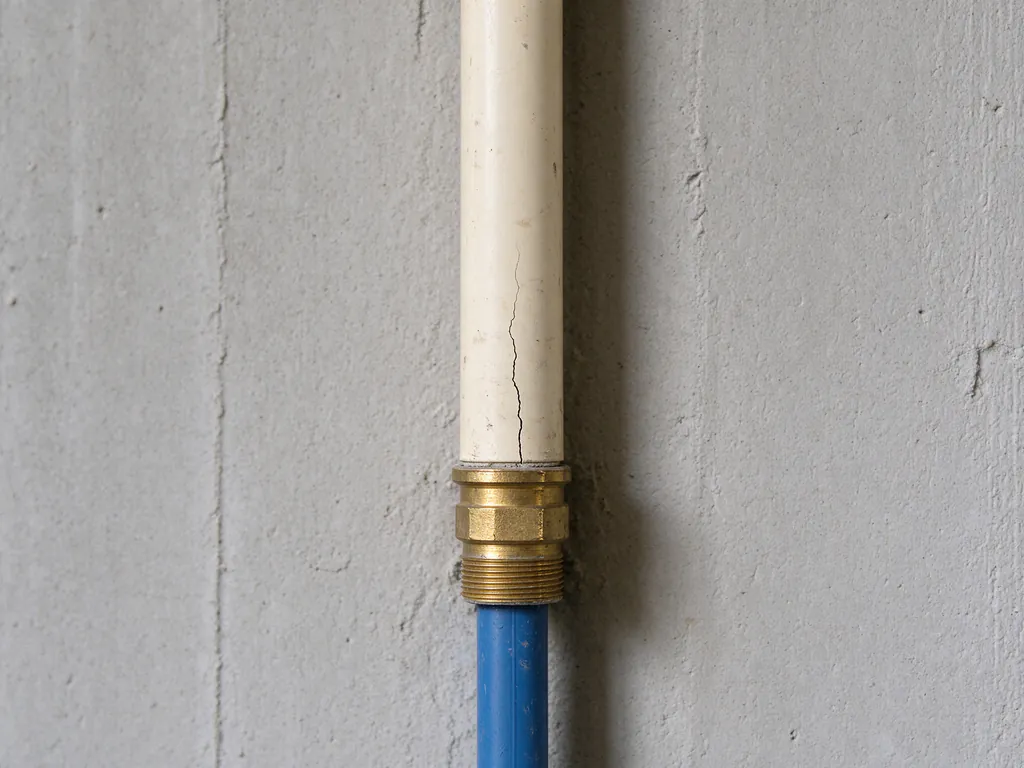
- cracks near fittings with no impact to explain them
- freeze damage in several places
- yellowed or darkened pipe near the water heater or in the attic, combined with leaks
Signs that do not by themselves:
- the house simply has CPVC
- one leak at a joint that can be traced to a bump or a single bad fitting
- a home inspection note that names the material without describing damage
Rule out other causes before blaming the pipe. High pressure strains every joint, and Austin’s code requires a regulator with a strainer above 65 psi static, set to 65 psi or less, with an expansion tank downstream. A water heater without an expansion tank on a closed system can spike pressure every heating cycle. The pressure-reducing valve guide explains the check.
Brittle pipe or one bad joint?
A walk-through checks where the CPVC runs, reads static pressure at a hose bib and sets out repair and repipe options as written lines.
CPVC vs PEX
| CPVC | PEX | |
|---|---|---|
| Form | Rigid lengths, glued fittings | Flexible tubing, mechanical fittings |
| Joints in a typical house | Many | Fewer |
| Freeze | Cracks or splits | Tubing tolerates more; fittings can still crack |
| Heat and sunlight | Becomes brittle | Must be shielded from sunlight |
| Repairs on old pipe | Can crack next to the repair | Straightforward with listed fittings |
| Typical use today | Repairs and some existing systems | New runs and repipes |
PEX is the usual replacement because it runs in long lengths with fewer joints and handles a freeze better. Copper is an alternative where pipe will be exposed. Neither is the best choice in every house; the PEX vs copper guide explains the trade-offs and the PEX repiping page covers the work.
Your options, from smallest to largest
Spot repair. Cut out the failed joint or section and replace it with new CPVC or a transition to PEX. It suits one leak in pipe that cuts cleanly. If the pipe shatters or cracks when cut, that is a strong sign the repair will not be the last.
Partial repipe. Replace the failing part: often the hot-water lines, which age fastest, or the attic runs exposed to heat. Listed transition fittings connect new pipe to the CPVC that stays. A partial repipe works when the problem is confined; the estimate should say plainly which CPVC remains.
Whole-house repipe. Replace every supply line. It makes sense when leaks keep appearing in different places, the pipe is brittle throughout, or a remodel will open the walls anyway. The whole-house repiping page covers the scope, and the is repiping worth it guide helps weigh the cost against more repairs.
Fire sprinkler CPVC is a different system
Some Austin-area homes have residential fire sprinklers fed by orange CPVC. That pipe belongs to the fire protection system, which in Texas is regulated separately from plumbing by the State Fire Marshal’s Office. Homeowners report that after the 2021 storm, a plumber declined to repair cracked sprinkler pipe because it fell under that separate license. Austin’s code also treats these homes differently: its pressure amendment allows up to 80 psi where a multipurpose fire sprinkler system is required. If a cracked pipe is orange or connects to sprinkler heads, identify it before calling.
Four questions that settle it
- How many leaks, and where? One leak with a clear cause is a repair. Leaks at different joints over a few years point to the pipe.
- How does the pipe behave when cut? A clean cut means repairs are still sound. Cracking or shattering means each repair risks the next leak.
- Where does it run? CPVC in a hot attic or near the water heater ages faster than CPVC inside conditioned walls, so a partial repipe of those runs can buy the rest of the system time.
- What is the pressure? If static pressure is above 65 psi and nothing controls it, fix that first; otherwise new pipe inherits the same strain.
If the answers are mixed, a repipe assessment walks through them for your house, and a first visit checks the pipe material, the static pressure at a hose bib and the attic or crawlspace before anyone recommends a scope. Where CPVC stays in place after a partial repipe, a note of where it runs and where each transition sits helps the next repair and the next buyer.
What replacing CPVC costs
Pricing for CPVC replacement depends on how much is replaced and where it runs. The drivers are the number of fixture groups, attic and crawlspace access, how many walls need opening, whether a second story is involved, the patch scope, and the permit and pressure test. A whole-house repipe falls within the typical Austin-area range of $4,500 to $15,000+, and about $4,500 to $9,000 for PEX with typical access. A partial repipe is priced from its scope. The Austin repipe cost guide explains each line, and the cost estimator gives a starting range for your house.