Yes, if static pressure at the house is above 65 psi. Austin’s amendment to the 2024 Uniform Plumbing Code requires an approved pressure reducing valve with a strainer whenever local static pressure exceeds 65 psi, set to 65 psi or less, with an NSF 61 expansion tank installed after it. Grackle Repiping Austin reads static pressure at a hose bib on every first visit and adds the valve and tank to a repipe where the reading calls for them.
What Austin’s 65 psi rule requires
The City of Austin adopted the 2024 Uniform Plumbing Code with local amendments under Ordinance 20250410-042, effective July 10, 2025. Amendment 608.2 sets out the pressure rule, and it is published on the City’s building technical codes page.
| Requirement | What it means at the house |
|---|---|
| Regulator above 65 psi static | An approved pressure reducing valve with a strainer, controlling every outlet in the house |
| Setting | 65 psi or less |
| Location | Above ground or in a vault, and protected from freezing |
| Expansion tank | An NSF 61 listed tank downstream of the regulator |
| Pipe sizing | New pipe is sized on 80 percent of the reduced pressure |
| Exception | Homes required to have a multipurpose fire sprinkler system may run up to 80 psi |
The 80 psi figure people quote comes from the generic model code text and from Georgetown’s operating range. In the City of Austin, the number that triggers a regulator is 65. The repipe permit guide explains how the City inspects this work.
Why high pressure matters to pipe
High static pressure is not what makes old pipe fail, but it shortens the life of everything connected to the system. Every joint, valve seat, toilet fill valve, washer hose and water heater fitting sits at that pressure around the clock. Pressure spikes add to it each time a fast-closing valve shuts and the water slams to a stop, which is the bang called water hammer.
Austin homeowners report static pressure well above 100 psi in parts of southwest Austin and the suburbs. Over five years of City plumbing permits, regulator work clusters on the hilly west and southwest side, in ZIP codes such as 78739, 78730, 78749, 78756 and 78731. That is evidence of where high pressure shows up, not a pressure map; a gauge is still the only way to know a given house. The Northwest Austin page and South Austin page cover those areas.
Why the expansion tank comes with the valve
A pressure reducing valve works like a one-way door: water passes into the house but cannot push back out to the street. That closes the system. When the water heater warms a tank of cold water, the water expands, and in a closed system it has nowhere to go, so pressure climbs every time the heater fires.
An expansion tank gives that water somewhere to go. It holds an air cushion behind a rubber bladder that compresses as the heated water expands, then pushes the water back as the house draws it. Without one, the temperature and pressure relief valve on the water heater may drip or discharge, and pressure in the house swings between its set point and something much higher. That is why Austin’s code requires the tank, not just the valve.
Signs a pressure reducing valve is failing
Regulators fail slowly, in either direction. Homeowners in Austin report valves failing around ten years in, buried valves with no box, and meter work that disturbed or removed the valve. Watch for:
- static pressure above 65 psi on a hose bib gauge, or a reading that climbs overnight
- pressure that swings, strong one moment and weak the next, with no other fixture running
- the water heater relief valve dripping, or toilets that run after filling
- banging pipes when a washing machine or dishwasher valve closes
- low flow everywhere at once that started suddenly, from a clogged strainer or a valve stuck nearly shut
A valve that is still sound can sometimes be adjusted or have its strainer cleaned. One that cannot hold its setting gets replaced. The low water pressure guide covers the low-pressure side of the problem.
Wondering what your pressure actually is?
The first visit puts a gauge on a hose bib and checks the regulator and expansion tank before anything else.
Where the valve fits in a repipe
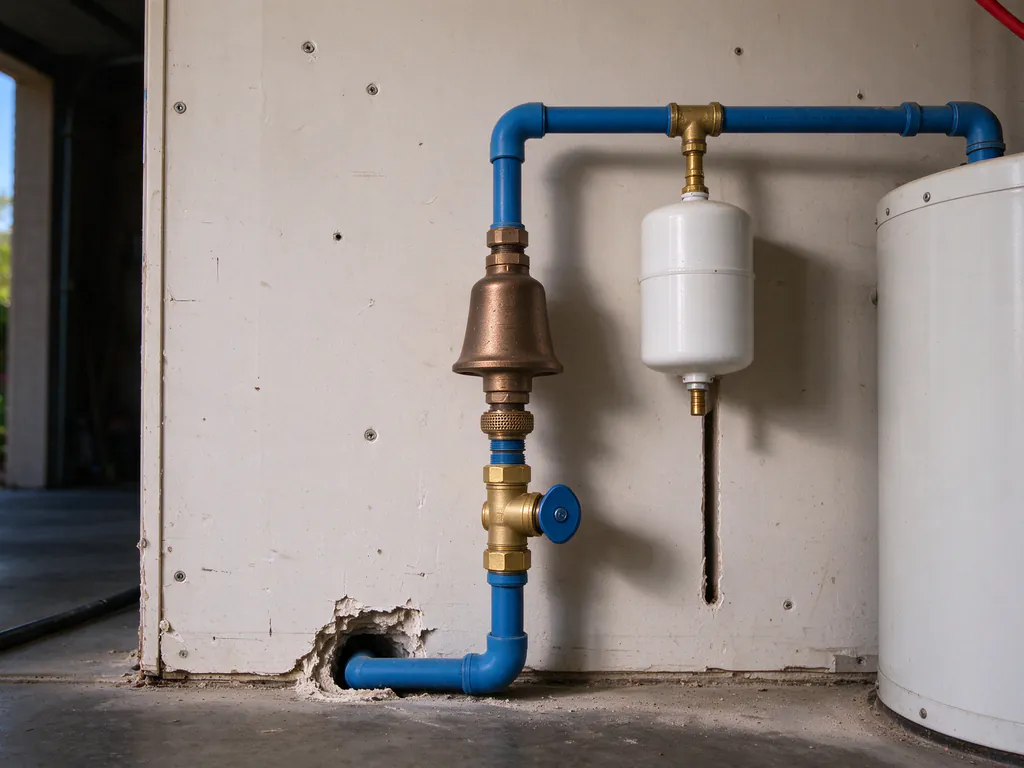
A repipe in a house above 65 psi includes the regulator and expansion tank, because Austin’s rule applies to the new system and because new pipe should not start life at street pressure. The regulator usually goes where the service line enters the house; the tank goes on the cold supply near the water heater. New pipe is sized on the reduced pressure. A whole-house repipe or a PEX repipe is the natural time to add both, since the lines at the entry and the heater are being rebuilt anyway.
Austin’s code also bars a new full-way valve on the meter discharge from being installed inside the City’s meter box without Austin Water’s consent, so a new customer shutoff goes just outside the box. A water line replacement from the meter is the other job where the regulator and shutoff get rebuilt together.
The cost of a regulator and tank depends on the valve size, where it has to go, whether an old valve must be dug out of the yard, and the expansion tank. It is listed as its own line on an estimate. The Austin repipe cost guide shows how it sits inside a full repipe price.
Oltorf, Travis Heights and Georgetown
Oltorf at Travis Heights. Austin Water is connecting the Oltorf corridor near Travis Heights, now in its Central Pressure Zone, to stronger pressure areas to form a new South Reduced Pressure Zone. As part of the project, Austin Water says it will install pressure reducing valves at certain points and on some properties, and where necessary provide and install thermal expansion tanks free of charge. Affected owners receive a notice and a right-of-entry form. If you are in that corridor and planning a repipe, check for that notice before paying for a valve. The Oltorf pressure zone post and Austin Water’s project page have the details.
Georgetown. Georgetown Water says parts of its system run at 80 to 100 psi, while others sit at 45 to 50, and it recommends that all customers install private pressure reducing valves. It also notes that most fixtures are designed for 60 to 80 psi. The Georgetown page covers the local permit rules.
The rebate question
Austin Water once offered a residential pressure regulating valve rebate. Its current residential rebate list no longer includes one, and the old application form is no longer online, so do not plan a valve around a rebate. Austin Water’s commercial and multifamily rebate page still lists a pressure regulating valve rebate for multifamily properties; the multifamily repiping page covers that work.