Texas pipes freeze because Texas houses are built for heat. Water lines can run through vented attics, inside outside walls and up from the slab at the edge of the house, in a climate where a hard freeze is rare. When one does arrive and stays below freezing for days, those pipes have nothing protecting them. Grackle Repiping Austin offers and manages repiping and burst pipe repair across the Austin area, and this guide explains where the risk sits and what reduces it.
How often Austin freezes
Austin freezes every winter, but not much and not for long. According to the National Weather Service, sub-freezing temperatures occur on about 12 days a year at Camp Mabry in central Austin and about 33 at Austin-Bergstrom, which sits in the low-lying Onion Creek basin to the southeast. The average first freeze is December 1 and the average last freeze is February 15. The coldest recorded low is minus 2 degrees, on January 31, 1949.
That gap between the two stations matters. Low-lying east and southeast Austin freezes two to three times as often as central Austin, so attic and outside-wall pipe there sees more cold nights.
The freezes that burst pipes
Most cold nights do not burst pipes. The ones that do are multi-day hard freezes, with lows in the teens and daytime highs near or below freezing, so the house and attic never warm up. Records from NOAA’s climate data for Camp Mabry and Austin-Bergstrom show how the recent events compare:
| Event | What happened in Austin |
|---|---|
| February 2021 (Winter Storm Uri) | Highs at or below freezing for five days at Camp Mabry; lows of 13, 8 and 7 degrees on February 14 to 16, and 6 at Bergstrom; 10 straight days with lows at or below freezing |
| December 22 to 25, 2022 | Lows of 15 to 18 degrees at Camp Mabry and 14 at Bergstrom; a high of 32 on December 23 |
| January 30 to February 2, 2023 | An ice storm, not a hard freeze: lows of 29 to 30 degrees, but more than 200,000 Austin-area customers lost power |
| January 14 to 17, 2024 | A high of 24 degrees at Camp Mabry on January 15, lows of 16 to 17 for four days, and 11 at Bergstrom |
| January 25 to 27, 2026 | A high of 28 at Camp Mabry, lows of 18 to 20, and 16 at Bergstrom |
The February 2021 storm left a mark in City records. Austin plumbing permits issued from February through April 2021 whose descriptions mention a freeze, frozen pipe, burst or the winter storm numbered 123, against zero to five in the same months of other recent years. Local news reported one Austin plumbing company booked into early March, which is a reason to prepare before a freeze rather than plan on a fast repair after one. The 2023 ice storm was different: the danger to pipes came from long power and heat outages, not from the temperature alone.
Which pipes freeze first
Pipe freezes where it is coldest and the water is still. In a Central Texas house that usually means:
- Attic lines. In a vented attic the space above the ceiling insulation is close to outdoor temperature. Lines strung high under the roof deck or near the eaves get the least heat from the house. The PEX in a Texas attic guide covers routing and insulation.
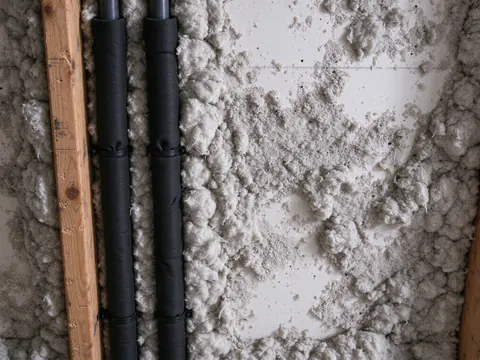
- Pipes in outside walls. A supply line in an exterior wall, especially a north wall, has only the wall’s insulation between it and the cold.
- Risers at the slab edge. Where supply lines come up out of the slab at the foundation edge inside an outside wall, they can sit in the coldest corner of the house.
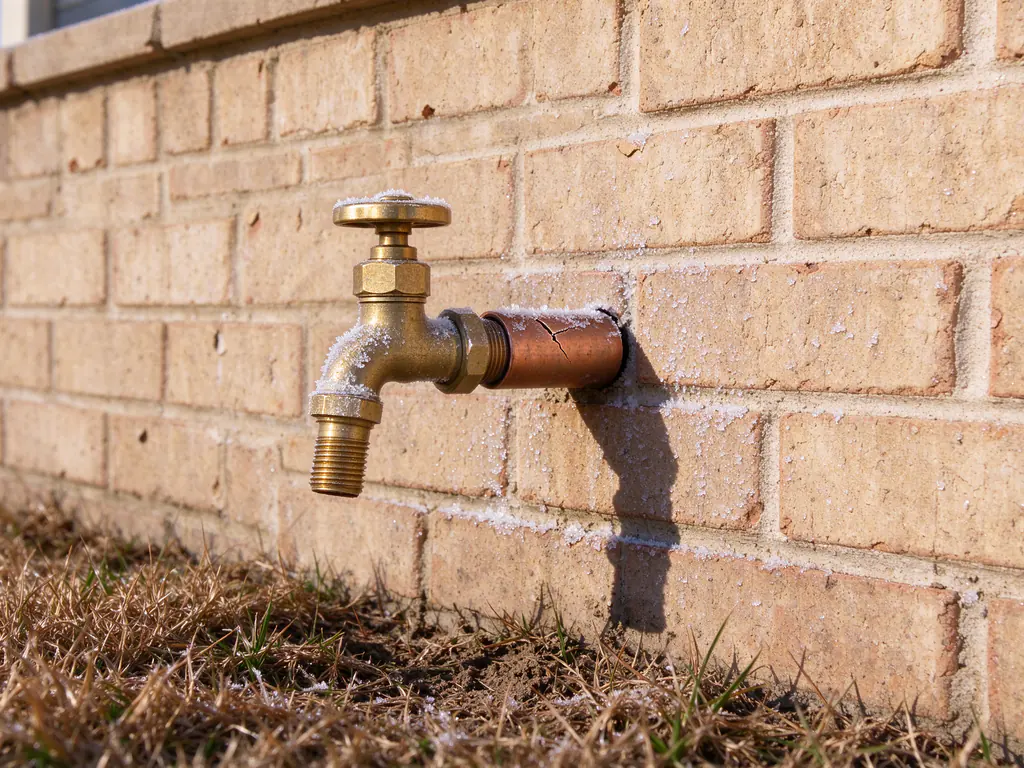
- Hose bibs and exposed pipe. Outdoor faucets, the pipe that feeds them and any exposed riser where the yard line enters the house, which is part of a water line replacement when it fails.
- Lines in unheated spaces. Garages, and crawlspaces under pier-and-beam houses.
Why a frozen pipe splits
Water expands as it freezes. In a pipe, an ice plug forms at the coldest spot, and as more ice forms it pushes water toward the closed faucets downstream. Pressure in that trapped section climbs until something gives. The split often appears away from the ice itself, which is why a burst can show up in a wall some distance from the cold spot.
Rigid pipe gives way soonest. Homeowners report copper lines splitting lengthwise in the February 2021 storm. CPVC can crack, and the CPVC guide covers when cracked CPVC points to replacement. PEX stretches more before it fails, but its fittings and the valves and fixtures connected to it do not stretch. A dripping faucet helps because moving water is slower to freeze and an open faucet gives that pressure somewhere to go. It is not a guarantee, especially for a line in an attic or outside wall that the drip does not serve.
Before a hard freeze
Know where your shutoff is. Austin Water says to use the property owner’s shutoff valve first, typically on your side of the water meter at the meter box. If you cannot find it or it is damaged, use the City shutoff in the meter box; you may need a water meter key, sold at hardware stores. Find and test it before the cold arrives.
Keep the house warm. Austin Water recommends setting the thermostat to 65 degrees or higher if you leave town, and turning the water off at the meter.
Help vulnerable pipes. Open cabinet doors under sinks on outside walls, disconnect garden hoses, cover hose bibs and let faucets on the coldest lines drip.
Consider draining down if the house will be empty or without heat. Shutting off the main and opening faucets removes most of the water and the pressure. Water can stay trapped in low spots, so it lowers the risk without removing it.
Want attic and outside-wall pipe looked at before winter?
A walk-through checks where your water lines run, how they are insulated and where the shutoffs are.
If your pipes freeze
Austin Water’s steps for thawing a frozen pipe are simple:
- Turn off the water at the shutoff first.
- Open a faucet on the frozen line.
- Apply gentle heat: a hair dryer, a heating pad or warm towels.
- Never use an open flame.
- Check the pipe for cracks once it thaws, and call a licensed plumber if it fails.
Turning the water off first matters. A split pipe often leaks only once the ice melts, and if the water is on, it leaks at full pressure.
After a pipe bursts
Shut off the water, then deal with the water already in the house. A typical Austin-area burst pipe repair for the pipe work alone runs about $400 to $1,500; ceiling, slab or multi-break repairs and drywall and water-damage restoration cost more. In Austin, a repair that replaces or reroutes pipe generally needs a plumbing permit, while fixing a leak without replacing pipe generally does not; the Austin repipe permit guide explains the rule.
For insurance, the Texas Department of Insurance answers “My pipe burst due to freezing. Will my insurance pay for the damage?” in its FAQ for damaged homes. The answer depends on your policy. The slab leak insurance guide explains how water damage claims tend to split between the pipe and the damage.
Does new pipe stop freezing?
Not on its own. New material alone does not remove freeze exposure; where the pipe runs and how it is insulated do. That is why the City of Austin’s plumbing code requires insulation at least five-eighths of an inch thick, with a minimum R-4 value, on water lines outside the building’s thermal envelope.
When a house is repiped or a slab leak is rerouted, the route is the main freeze decision. Lines laid low across the ceiling joists under the attic insulation stay warmer than lines strung under the roof. Drops in interior walls stay warmer than drops in outside walls. A valve that isolates the attic run makes a future freeze easier to handle. The whole-house repiping page and the PEX vs copper guide explain how those choices are made, and the pipe identification guide helps if a freeze has left you unsure what is in your walls.
If a freeze has cracked pipe in several places, or the pipe was already old and leaking, a freeze can be the moment to weigh a repipe against another round of repairs. The is repiping worth it guide walks through that decision.