Reroute when the leak is in a long or hard-to-reach line, under a finished floor, or in pipe that has already leaked elsewhere. Repair the spot when there is one leak, in an accessible place, in pipe that is otherwise sound. Repipe when leaks keep coming or the pipe material itself is the problem. Grackle Repiping Austin offers and manages all three across the Austin area, and the right one depends on what leak detection finds.
Start with what leak detection found
Every slab leak decision starts with the same three facts: which line is leaking, where it is, and whether the other lines under the slab hold pressure. Without them, there is nothing to choose between.
Detection usually starts at the meter. With every fixture off, a moving meter means water is going somewhere. The plumber then isolates lines, at a manifold, at the water heater or by closing valves, until one line loses pressure on a gauge and the others hold. Acoustic listening and thermal imaging narrow the spot on a line that is already known to leak. The slab leak signs guide covers what a homeowner sees before that point.
The result shapes the choices like this:
- One line leaks, the others hold. All three fixes are on the table.
- The leak is pinpointed, in open floor. A spot repair becomes realistic.
- The leak is under a tub, shower pan, cabinet run or tile that cannot be matched. A reroute usually wins.
- More than one line leaks, or this is not the first leak. A whole-house repipe belongs in the comparison.
A leak on a drain line under the slab is a different problem: it does not run the meter, it is found with a camera, and it is separate work from a supply reroute. The guide on drain pipes explains that boundary.
The three fixes, side by side
| Spot repair through the slab | Reroute overhead | Whole-house repipe | |
|---|---|---|---|
| What changes | One section of the leaking line | The whole leaking line, abandoned in the slab and replaced through the attic | Every supply line, usually run overhead |
| Floor work | Floor and slab opened at the leak, then patched | None; openings are in walls and ceilings | None; openings are in walls and ceilings |
| What stays in the slab | The rest of the old line, still in service | The old line, capped and abandoned | Old lines capped and abandoned |
| Best fit | One leak, pinpointed, in open floor, in sound pipe | A long line, a leak under finishes, or uncertain pipe | Repeated leaks, or pipe material that is failing |
| Typical Austin-area price | No published range; priced from the location and floor finish | About $4,000 to $9,750 before leak detection | $4,500 to $15,000+ |
The slab leak reroute cost guide breaks down what sits inside the reroute price, and the Austin repipe cost guide does the same for a full repipe.
When a spot repair makes sense
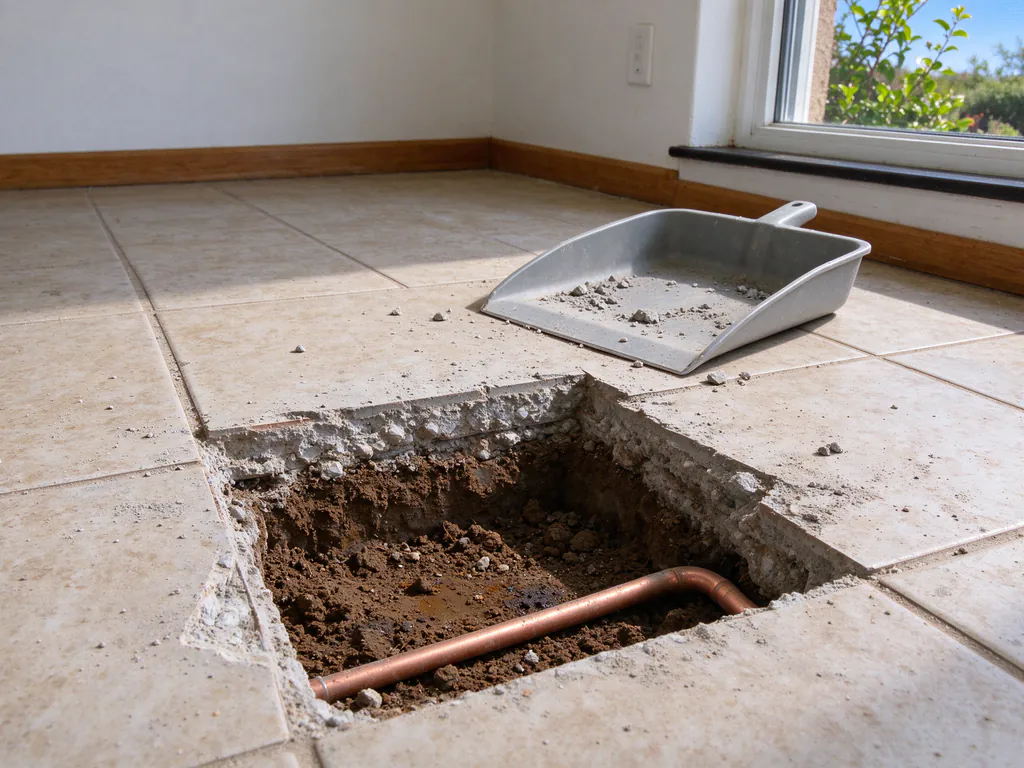
A spot repair opens the floor directly over the leak, breaks out the slab, repairs the pipe and backfills and patches the concrete. It changes the least, and when the conditions line up it can be the right call.
The conditions are specific. The leak should be pinpointed, not estimated. The spot should be under floor that can be cut and replaced, such as carpet, vinyl or a tile you still have spares for, not under a tub, a shower pan or a kitchen island. And the rest of the line should be sound, because a spot repair leaves every other foot of that line in the slab and in service.
Homeowners report a second cost here: after the plumbing is fixed, the floor still needs putting back. Tile, wood and leveling are often separate from the plumbing price, and on a finished floor they can rival the repair itself.
When a reroute is the better fix
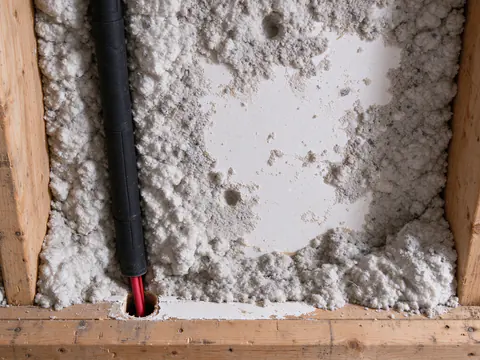
A reroute caps the leaking line where it leaves the slab, abandons it, and runs a new line overhead through the attic and down inside walls to the same fixtures. Nothing under the floor is opened.
It tends to win when:
- the leak sits under a finish that is expensive to break and replace
- the line is long, so finding the next leak on it would mean breaking the floor again
- the leak cannot be pinpointed closely enough to break the slab with confidence
- the slab sits on expansive clay, where the line may keep moving
That last point matters in parts of Austin. Houston Black clay, common in central, south and east Austin, shrinks and cracks in dry spells, with cracks of half an inch to four inches at a foot down according to the USDA NRCS soil description, and swells when wet. Pipe in or under a slab on that soil moves with it. That does not prove why any one line leaked, but it is a reason not to assume the repaired line will stay put. West-side neighborhoods on shallow limestone see much less soil movement.
Austin permit records show how routinely a supply leak under a slab is answered with a reroute. Across five years of City plumbing permits, 149 describe rerouting a water line, and more of them mention the attic or overhead routing than the slab. A reroute does put pipe in the attic, which brings heat in summer and freeze exposure in winter; the PEX in a Texas attic guide covers how that line should be insulated, supported and routed.
Not sure which fix fits your leak?
A walk-through checks the pipe, the pressure, the attic and the walls before anyone recommends a reroute or a repipe.
When the answer is a whole-house repipe
A whole-house repipe is the fix when the problem is the pipe rather than one point on it. The signs are a second or third leak, leaks on both hot and cold lines, or a material with a known failure pattern, such as polybutylene or galvanized steel. Homeowners report repeat slab leaks rerouted one at a time over years, and each one brings its own detection visit, permit, wall openings and patching.
Once there are two leaks in the same under-slab system, compare the cost of the next reroute with the cost of a whole-house repipe, not just this one. A repipe abandons every line in the slab at once. In a slab house it runs overhead the same way a reroute does, so the attic considerations are the same. The is repiping worth it guide walks through repeat-leak decisions in more detail.
Questions that settle the decision
Before you agree to any of the three, these questions sort out most cases:
- Has the leak been confirmed on a supply line, and on which line? If not, the scope is a guess.
- Do the other lines hold pressure? A second leak changes the comparison.
- What is directly above the leak? Tile, a tub or cabinets favor a reroute.
- What is the pipe, and has it leaked before? Copper, polybutylene and galvanized steel each fail differently; the pipe identification guide shows how to tell.
- What does the attic allow? Headroom, roof shape and insulation decide where a new line can run.
- What is the static pressure? Austin’s code calls for a regulator above 65 psi, and high pressure strains every joint, old or new.
Permits for each fix in Austin
The City of Austin adopted the 2024 Uniform Plumbing Code with local amendments, effective July 10, 2025. Its amendments exempt repairing a leak from a permit only when the work does not replace or rearrange pipe, valves or fixtures. A reroute rearranges pipe and a repipe replaces it, so both need a plumbing permit pulled by a Texas-licensed responsible master plumber registered with the City. A spot repair that cuts out and replaces a section of pipe generally needs one too; the City confirms the edge cases. Suburbs set their own rules, and Kyle’s permit handout specifically lists repairs that require removing concealed piping. The Austin repipe permit guide covers each city.
Whichever fix you choose, the new pipe should be pressure tested and inspected before walls or the floor close, and the estimate should list the permit, the test and the patch scope as separate lines.
If insurance is part of the decision
Insurance can tilt the choice, but only after you know what your policy actually says. Policies in Texas differ, and homeowners report insurers treating access to the leak and resulting water damage differently from the failed pipe. That can matter when one fix involves breaking the slab and another does not. Read the slab leak insurance guide and talk to your agent before you pick a fix on the assumption that part of it is covered. The slab leak reroute page explains how the reroute itself runs, from the first visit to the inspection.