In much of South Austin and Southwest Austin, the repiping conversation starts after a slab leak, not before one. These four ZIP codes, 78745, 78748, 78749 and 78739, account for 36 of the City’s 149 water reroute permits from October 2021 to October 2026, tied with Northwest Austin for the most of any part of the city, and 78749 alone leads every Austin ZIP code with 13. The reader’s real question is whether to reroute the leaking line or replace the supply system.
Grackle Repiping Austin offers and manages slab-leak reroutes and whole-house repiping across Westgate, Garrison Park, Sweetbriar, Western Oaks and Circle C Ranch. Licensed and insured plumbing contractors do the work, and a City-registered responsible master plumber pulls the permit. Pressure comes into almost every one of those decisions here, so it gets measured on the first visit.
The reroute-or-repipe decision
Austin’s plumbing permits describe the local fix plainly. A typical entry reads: “Abandon the leaking 3/4 hot water line in the foundation & reroute it overhead in the attic.” Of the 149 reroute permits citywide, 80 mention the attic, overhead or ceiling. Rather than break the slab to reach a leak, the leaking line is capped where it enters the floor and a new line is run through the attic and down a wall to the fixture it served.
The table compares the two paths for a typical one-story slab house of the 1970s or 1980s.
| Reroute one line | Whole-house repipe | |
|---|---|---|
| What changes | The leaking line is capped and replaced overhead | Every hot and cold supply line is replaced, usually through the attic |
| Typical Austin-area range | About $4,000 to $9,750, before leak detection | $4,500 to $15,000+; about $4,500 to $9,000 for PEX with typical access |
| Pipe in the slab afterward | The other slab lines stay in service | Every slab line is capped and abandoned in place |
| Best fit | Sound pipe with one isolated failure | Pinholes elsewhere, repeat leaks, or several lines through the same slab |
Where the house is plumbed in copper and one hot line fails, the rest is often the same age and the same wall thickness. Homeowners report repeat slab leaks in the same house, and each reroute adds another set of openings. The slab leak repair or reroute guide and the reroute cost guide set out where the line between the two choices usually falls, and the slab leak reroute page covers the work itself.
Clay in 78745, limestone in 78749 and 78739
The ground is different on either side of MoPac’s southern end, and it changes how a slab leak should be read. 78745, around Westgate, Cherry Creek and Garrison Park, has 42.6% of its homes built from 1970 to 1989 and a median year of 1984. At the repipe and reroute permit locations there, the federal soil survey maps Houston Black clay as the main soil, and 8 of 21 locations are rated high for shrink-swell. In dry spells Houston Black opens cracks as wide as four inches a foot below the surface, then closes them as it takes on water, so a slab on it rises and settles through the year, and pipe passing through the slab moves with it. 78745 also ranks third in Austin for permit descriptions that mention slabs, with 101.
West of MoPac, 78749 and 78739 sit on Eckrant and Speck soils, shallow layers over limestone, and only 1 permit location in each rates high for shrink-swell. Their houses are newer too: 78749’s median year built is 1993, 78739’s is 2003, and 78748’s is 2004. Slab leaks still happen there, from pinholes, corrosion and pipe rubbing where it leaves the concrete, but heaving clay is a weak explanation. The copper pinhole leak guide covers those causes.
High pressure on the southwest side
Regulator work concentrates here. Per 10,000 housing units, 78739 has the highest rate of City permits that mention a pressure reducing valve, 41.8, and 78749 is third citywide at 29.0, or 49 permits. Homeowners on the southwest side report static readings well above 100 psi. Austin Water’s polybutylene service replacement program also lists 78745, 78748 and 78749 among its ZIP codes and gives priority to lines where pressure exceeds 105 psi.
Austin’s code draws the line at 65 psi of static pressure. Above it, a house must have a pressure regulator fitted with a strainer and adjusted to 65 psi or lower, followed by an expansion tank listed to NSF 61 (City amendment to UPC 608.2). High static pressure adds stress to every joint, valve and water heater connection in the house, so a reroute or repipe here includes a pressure reading at a hose bib and, where needed, a regulator and tank written into the estimate. The pressure reducing valve guide explains how they work and how long they last.
Slab leak in Westgate, Western Oaks or Circle C?
Get the reroute and the full repipe priced side by side, with the pressure reading and attic route on the same estimate.
Attic runs in a production slab house
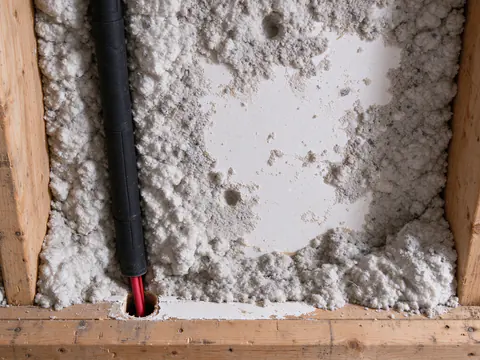
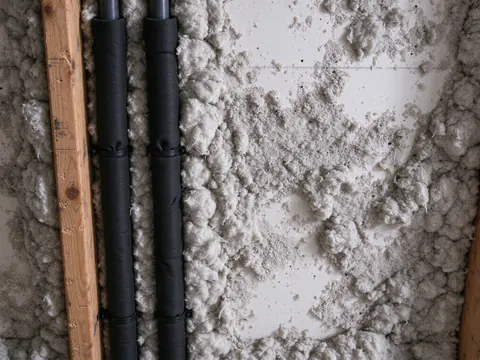
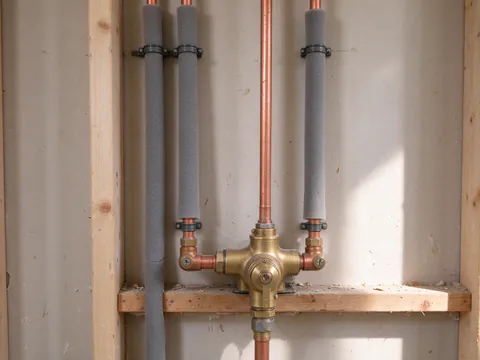
An overhead route puts the new lines in the attic of a slab house, where summer heat and winter cold both reach them. Any water line outside the thermal envelope has to be wrapped to at least R-4 under the City’s local code (section 312.6.1), which means insulation no thinner than 5/8 inch. The National Weather Service records about 33 days a year below freezing at Austin-Bergstrom, in the low Onion Creek basin, against about 12 at Camp Mabry, so low-lying ground away from the urban core can see far more freezing nights than the central city. Attic lines are insulated and supported off the hot roof deck. The guide to PEX in a Texas attic covers the details. A PEX repipe suits long overhead runs because it needs fewer fittings, and copper repiping remains a sound choice where an owner prefers metal.
The yard line stays yours
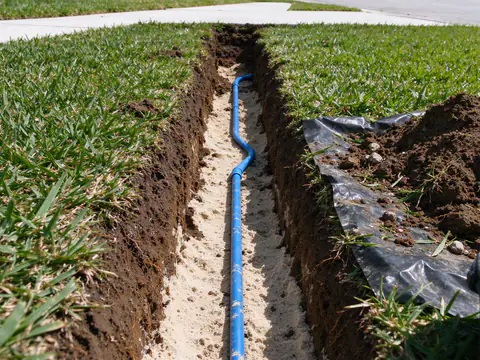
78745 has more water service and yard line permits than any other Austin ZIP code, 67 over the five-year window, with 78749 at 43 and 78748 at 37. The line from the meter to the house belongs to the owner. Austin Water’s polybutylene program replaces only the public side, from the main to the meter, so a new utility line does not mean a new yard line. Where a yard line leaks or the house needs a new main shutoff, the water line replacement page covers trenching, boring and the customer valve.
What the first visit and the work look like
After a slab leak, the first job is proving the leak is on a water supply line, since a drain leak calls for different work. The visit then records what the pipe is made of, puts a gauge on a hose bib for the static reading, checks how much crawl room the attic has and picks the walls where a line can drop. Separate estimate lines cover the City permit, the pressure test and the drywall patching, so two prices can be compared line by line. Through the job, water is restored every evening. City inspection follows a passed pressure test and comes before any wall is closed; whatever old pipe can be reached is removed, and the slab runs are sealed and left where they are.
North of Ben White and down I-35
North of Ben White, South Central Austin has older, mixed housing and a pressure-zone project near Oltorf. Northwest Austin is the city’s other reroute hotspot, on limestone like 78749. South along I-35, Kyle has its own permit office and hard groundwater.