

Cedar Park and Austin pull water from the same lake, yet the water at a Cedar Park tap is close to twice as hard. Austin Water lime-softens its Lake Travis supply to about 93 ppm; Cedar Park’s water report lists 183 ppm with a near-neutral pH. Grackle Repiping Austin offers and manages repiping in Cedar Park and Leander, from Buttercup Creek and Ranch at Brushy Creek to Crystal Falls and Travisso, with licensed and insured plumbing contractors doing the work. Repiping in Cedar Park, TX is shaped less by the age of the houses than by that water, the city’s own permit office and the limestone under the slabs.
Same lake, different water
Cedar Park’s water is Lake Travis surface water treated at a plant the City owns with two regional partners. The 2025 report lists hardness as calcium carbonate at 183 ppm, a pH of 7.6, total alkalinity of 144 ppm, calcium at 37.4 ppm and magnesium at 21.5 ppm, with chloramine as the disinfectant. In grains, that is about 10.7 per gallon, compared with about 5.4 for Austin.
The difference is treatment, not source. Austin lime-softens and raises its pH near 9.7; Cedar Park’s water arrives harder and closer to neutral. Hard water drops calcium scale where it heats or slows, so the first places it builds are the water heater, shower mixing valves, faucet aerators and the small passages in toilet fill valves. A flow complaint in a Cedar Park house is worth sorting into fixture scale or pipe restriction before anyone prices a repipe. The hard water guide explains how.
A repipe does not change the water. It clears built-up scale from old lines and fittings, but softening, filtration or a loop for a future softener are separate decisions. They are easiest to plan while the new lines are being laid out, so connections end up accessible instead of buried in a finished wall.
Cedar Park’s code and permit desk
Cedar Park adopted the 2021 International Plumbing Code, along with the 2021 residential and building codes and the 2020 electrical code, with local amendments in Chapter 3 of the City Code, effective June 1, 2022. Permits are issued through MGO Connect. None of Austin’s Uniform Plumbing Code amendments apply here, including its 65 psi regulator rule; pressure control on a Cedar Park repipe follows the code Cedar Park enforces and is confirmed with the permit.
The estimate lists the permit, the pressure test and the wall patching as separate lines. The City’s permit fee for a repipe is confirmed per address. The repipe permit guide explains what the inspection checks and why it happens before walls close.
No utility program to plan around
In parts of Austin, an interior repipe is sequenced with Austin Water’s replacement of flagged galvanized service lines. Cedar Park has no comparable step. Its service line inventory reports only non-lead lines, City-owned and customer-owned, with ownership generally split at the meter, and owners can look up their address through the City’s water report lookup. If the line from the meter to the house needs work, that is the owner’s project; the water line replacement page covers it.
Limestone ground and a 2000s housing stock
Of Cedar Park’s 29,364 homes, 65.9% were built in 2000 or later and only 5.8% predate 1980, according to the Census Bureau; the median house dates from 2005. A federal soil survey sample around the city found no high shrink-swell soils at any of nine points, mostly Eckrant and Georgetown soils over limestone. That is a different setting from the clay belt east of Interstate 35, where slab movement drives leak repairs.
So the reasons to repipe here are specific to the house. Repeat failures at one type of fitting, a freeze break in an exterior wall or attic, a remodel that already opens walls, or scale-choked fixtures and valves can each start the conversation. A partial repipe can replace the branches that are failing; a whole-house repipe makes sense when the problem is the system rather than one run. Where a line has already burst, the burst pipe repair page covers how the repair can also move the line out of harm’s way.
Leander
Leander, north along US 183 and the 183A Toll Road, runs its own permit office. It adopted the 2021 International Plumbing Code with local amendments, along with the 2021 residential, building and energy codes and the 2023 electrical code. A Leander repipe is permitted and inspected by Leander.
Leander’s water comes from a Lake Travis intake and from the Brushy Creek Regional treatment plant, disinfected with chloramine at an average of 2.40 mg/L. Its 2025 report does not publish a hardness value, so scale is judged at the house rather than assumed from Cedar Park’s figure. Leander publishes its service line inventory online, and no replacement program like Austin’s was found.
The housing is newer still: 84.7% of Leander’s 27,000 homes were built in 2000 or later, with a median year of 2013. A soil sample there found high shrink-swell soil at one of nine points, mostly Eckrant and Fairlie. For houses in Crystal Falls, Travisso or around Old Town Leander, a repipe is more likely to follow a specific failure than age, and the guide on whether repiping is worth it helps sort a one-off leak from a system problem.
Repiping in Cedar Park or Leander?
The walk-through checks the pipe material, static pressure, attic access and where walls can open.
From the meter box to final inspection in Cedar Park
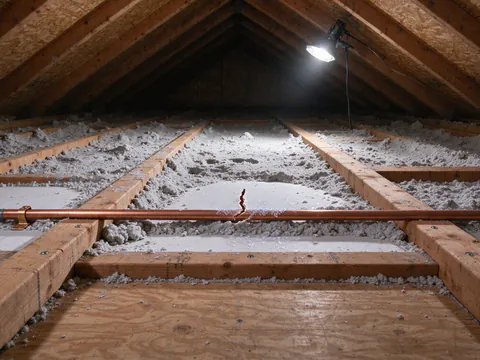
The first visit checks the pipe material in several places, reads static pressure at a hose bib, looks at the attic and any other access, and decides where walls can open with the least patching. Where a house has a second story, lines to the upstairs baths travel through the floor framing, so ceiling openings below are planned and listed on the estimate. Attic runs need insulation; the guide to PEX in Texas attics covers routing and freeze protection.
Water is back on at the end of each work day. The finished system is pressure tested and then inspected by the City before walls close. Reachable old pipe comes out; the rest is capped and abandoned in place. The PEX repiping page and the PEX vs copper guide help with the material choice, and the repipe cost guide explains what moves the price.
Next door to Cedar Park
East along the Brushy Creek corridor, Round Rock reports even harder water and runs a one-permit system. To the north, Georgetown puts pressure control first. South into Austin, Northwest Austin shares the limestone ground but sits on Austin Water and Austin’s code.