
Round Rock’s own water report describes its water as very hard: an average of 249 mg/L, or roughly 14.6 grains per gallon. That is about 2.7 times the 93 ppm average Austin Water reports, and it shapes nearly every plumbing decision in the city. Grackle Repiping Austin offers and manages repiping in Round Rock, from Round Rock West and Chandler Creek to Forest Creek and Teravista, with the work done by licensed and insured plumbing contractors. For repiping in Round Rock, TX, the job starts by separating what hard water has done to valves and fixtures from what age or the ground has done to the pipe itself.
Very hard water, and what a repipe can and cannot change
Round Rock blends three supplies: Lake Georgetown, Edwards Aquifer groundwater and Lake Travis water treated at the Brushy Creek Regional plant. The City’s water quality table shows hardness ranging from 100 to 358 ppm across the year, calcium averaging 70 ppm and a pH around 7.5. The disinfectant is chloramine.
Calcium carbonate drops out of hard water when it heats up or slows down. So the first deposits show up in the water heater, the mixing valves in showers and the aerators on faucets, not in the straight runs of pipe. A shower that loses flow in Round Rock is as likely to have a scaled cartridge as a restricted line, and the fix is very different. The hard water guide walks through how to tell them apart.
A repipe clears the scale that has built up inside old lines and old fittings, and new PEX or copper gives a smooth bore. It does not soften the water, and the same 249 mg/L keeps arriving at the meter the day after the job is done. That is why the layout of a Round Rock repipe deserves a decision about treatment: whether an existing softener or filter loop is reconnected, bypassed or planned for later, and where its connections sit so they stay serviceable. Material choice belongs in the same conversation; the PEX repiping page and copper repiping page cover how each handles fittings, joints and access.
One permit, every contractor named on it
Round Rock’s Building Inspection division requires a permit for the installation, alteration, repair or replacement of any plumbing system within city limits, and the same rule covers the Chandler Creek and Vista Oaks MUDs. The City runs a strict one-permit system: every contractor working on the project is listed on the single permit, and contractors must register with the City before they can be listed.
The City adopted the 2024 International Plumbing Code, not the Uniform Plumbing Code Austin uses. Austin’s local amendments, including its 65 psi regulator rule, do not apply here; pressure control on a Round Rock repipe follows the code Round Rock enforces, and the details are confirmed with the permit. The standalone plumbing trade permit is $50, with two inspections of the same type included. The City does not say on that page whether a whole-house repipe is filed as a standalone permit, so the permit type is confirmed when it is pulled. The estimate lists the permit, the pressure test and the wall patching as separate lines.
Where the 1970s and 1980s houses fit
Round Rock holds the largest block of 1970s and 1980s housing among the Austin suburbs. Of its 51,143 homes, 21.6% were built from 1970 to 1989, and 10.5% predate 1980, according to the Census Bureau’s American Community Survey. The median house dates from 2002, so the city is mostly newer, but a house built in those two decades is now thirty-five to fifty-five years into its original plumbing, and any repairs since then have been made against hard water the whole time.
Houses of that age can hold almost anything: copper, older plastic lines, or a patchwork of both after earlier repairs. The guide to identifying your pipes shows what to look for at the water heater and under sinks. Where a house turns out to have polybutylene, the polybutylene pipe replacement page explains the scope; where most of the system is sound, a partial repipe can target the failing branches and leave the rest written into the scope.
Clay at three of nine sample points
A federal soil survey sample around Round Rock found high shrink-swell soils at three of nine points, mostly Houston Black and Sunev clays. Expansive clay swells when wet and shrinks in drought, and a slab sitting on it moves with the seasons. Water lines poured into or under that slab move with it, and joints and fittings are where the strain tends to show.
Homeowners in the area report repeat slab leaks in the same house and the worry that each one means foundation trouble. A leak in a supply line does not by itself prove the foundation is failing, but a second or third leak changes the math. Instead of breaking the floor again, the line can be abandoned in the slab and replaced with a new run through the attic and down a wall. The slab leak reroute page covers how that works, and the repair or reroute guide compares the two paths.
Planning a repipe in Round Rock?
Start with a walk-through that checks the pipe material, the static pressure and how the attic or walls can open.
A Round Rock job, permit to patch
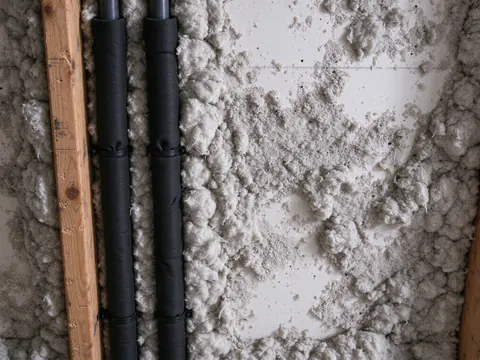
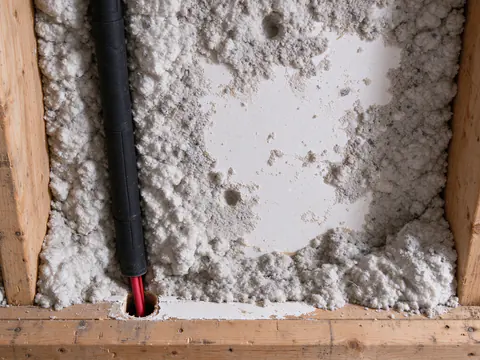
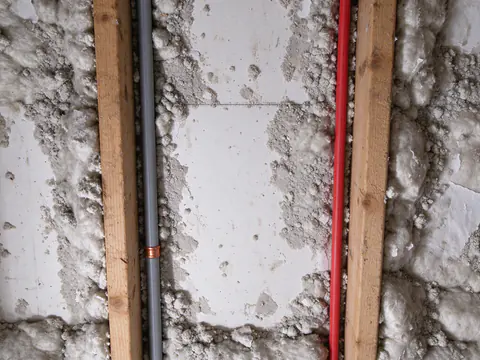
The first visit checks what the pipe is made of at several points, measures static pressure at a hose bib, looks at attic access and decides where walls can open with the least patching. In a one-story slab house, the new hot and cold lines usually run through the attic and drop to each fixture group. Attic runs need insulation, and the February 2021 storm showed central Texas what an uninsulated attic line does in a hard freeze; the guide to PEX in Texas attics covers routing and protection.
Water is back on at the end of each work day. When the new system is complete, it is pressure tested, then inspected by the City before any wall closes. Old pipe that can be reached is removed; pipe left in the slab or inside closed walls is capped and abandoned in place. The new lines are flushed after cutover, which matters more in hard water, because loosened scale from old fittings and the water heater can lodge in new valves. The whole-house repiping page covers the full sequence, and the repipe cost guide explains what moves the price.
Round Rock’s water, its neighbors and the service line
Round Rock’s water report points customers to the City’s service line inventory and explains which part of the line the City owns and which part belongs to the customer. No free replacement program like Austin Water’s galvanized line program was found for Round Rock, so the line from the meter to the house is the owner’s to maintain. If it needs work, the water line replacement page covers that separate job.
North of the city, Georgetown has its own permit office and high operating pressure in parts of its system. To the west, Cedar Park draws from Lake Travis without Austin-style softening. South along Interstate 35, North Central Austin is where older galvanized pipe drives the work. If the question is whether to repipe at all, the guide on whether repiping is worth it is a good place to start.